Episode 008
Coach Gretchen Richter
Gymnastics Coach, Founder of GRL Academy
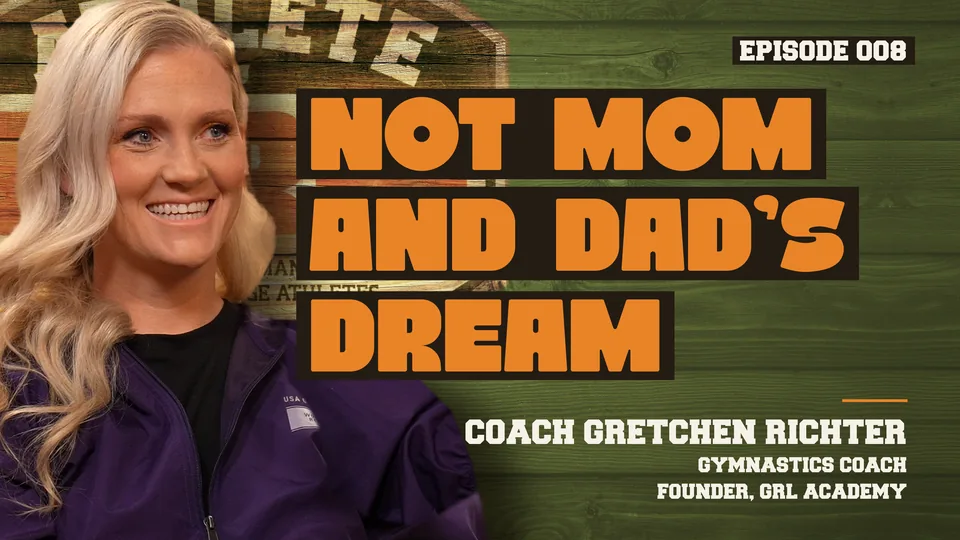
Coach Gretchen Richter started gymnastics at two, competed on beam for West Virginia and helped coach a fourteen-year-old Simone Biles through her first levels of elite. Now the founder of GRL Academy, she says five-hour practices are average at that level, and the best gymnasts are simply out-training everyone else.
Full transcript
0:40Mike Frascogna: Welcome back to Athlete Farm, your parenting almanac for growing college athletes. I'm your host, Mike Frascogna III, and today we're going to be talking gymnastics. I've got Coach Gretchen Richter here with me today over here from Dallas, Texas. And Gretchen is going to be a fascinating conversation. We haven't done anything in the world of gymnastics yet, but this is going to be a great entry point for us. Gretchen grew up in Madisonville, Texas, and now lives in Dallas. She was a gymnast from a very young age, which she'll share that whole experience with us. And then she ended up at West Virginia University as a Mountaineer, where during the big Pat White days and Rich Rodriguez football championships, you were part of burning couches, allegedly, at West Virginia University. She was a gymnast there. She was actually, before going to West Virginia, was the number five beam athlete in the country, which I think is probably where you got all the recognition and ended up at WVU. After she graduated from college, which is a great experience we'll hear all about, she then decided to go back into coaching to stick with gymnastics. She ended up working with Simone Biles, which is kind of a big deal. So we'll hear about that, too. And then also ended up as a coach at the legendary WOGA Gymnastics School, which is also a great story, and then went on to several additional places from there. She is now the founder and owner of GRL Academy, which we'll hear about, and also travels the world putting on gymnastics camps literally everywhere with part of the GP Impact System. Gretchen, thanks for being here.
Gretchen Richter: Thank you for having me.
2:28Mike Frascogna: Yeah well, we're going to dive right in and let's get into gymnastics. So there's lots of people that are far more educated on gymnastics than me. And you know my younger child, my youngest child, Petra, this is my first rodeo in gymnastics with her. It's been a lot of fun. I also realize how much I don't know. So I'm going to learn a lot from this interview with you. Tell me about growing up in Madisonville. How did you get into gymnastics and at what age?
Gretchen Richter: So I grew up in a very small town between Houston and Dallas, Madisonville, Texas. And at two years old, my mom was putting me in ballet classes and gymnastics and I hated the sound of tap shoes. And so I would scream and cry and then she put me into gymnastics and I just fell in love. So I started at two years old.
3:19Mike Frascogna: I didn't even know you could start at two. Yes. So you had told me earlier, maybe your first experience with gymnastics wasn't even in the gym. It may have been on a split rail fence.
Gretchen Richter: I well, I can tell you that a lot of my just backyard training, gymnastics and playing and falling in love with the sport was out on my father's ranch, cattle ranch. So, you know, I think and that's kind of how all kids fall in love with it is they flip in the grass and they play. And that is where it all began for me.
3:56Mike Frascogna: Yeah. Well, so when did you when you first joined a gym and. You know, at some point when you're young, you're playing around with it and you you realize I enjoy this. This is fun. And your parents sound like they they continued to feed that with you. Tell me a little bit about your parents and what they were providing for you at the time.
Gretchen Richter: I well, I'll start off by telling you my parents names, Barbara and Kenneth Richter. So they are the real life Barbie and Ken. They definitely introduced me to the sport of gymnastics, but much like you, they did not know much about it at all. They just knew that I loved it and they provided me the space to go and pursue it. And it definitely started accelerating quickly. And just the the more that I learned and the more that I continued to show interest, they were right along with me through that journey.
4:59Mike Frascogna: So how important is it to have supportive parents really in any sport, but specifically gymnastics?
Gretchen Richter: It's beyond important because gymnastics is the type of sport that requires a really strong, family unit. It requires, you know, I, I like to say that you have to have all of the ingredients in order to be able to pursue this sport and make it all the way. And those ingredients, in my opinion include, you know, a, a gym that is able to produce and get you there. Definitely the, the resources of maybe pulling outside, help in or coaches, things like that. But there's such a mental aspect of gymnastics that having parents that can help you navigate that side of it. After a hard day at practice or maybe a competition, you didn't do very well. It, it is so important.
6:03Mike Frascogna: What does that look like? You know, you, if you had a tough day or a tough competition, how did your parents handle it? How did they, how did they interact with you?
Gretchen Richter: Well, I, I definitely think different parents are going to react different ways. My, my parents basically told me if it's too hard for you, you don't have to do it. We can walk away from this gymnastics and never do it again. And I would sit with that for a while, maybe an hour. And then I would say, absolutely not. This is my favorite thing in the world. I want to go back. And so they very much always, made it my decision to continue the sport and to push myself to do it. But I, I definitely felt supported throughout my journey, just in every way possible, with my parents behind me.
6:57Mike Frascogna: So when you, when you begin this gymnastics journey, I assume at some point in there, you realize, you know, one, I'm pretty good at this and I really want to pursue this maybe more than some other people around me. When, when did, when did you realize that?
Gretchen Richter: I would say, you know, when I, when I first started gymnastics, I loved the concept of girls flying in the air and I wanted to be able to fly like that. I just thought it was mesmerizing. I'd never seen anything like it. And I just, I became addicted to it in a sense. But I think that there was just this built in desire to excel at something. And for me, gymnastics was something that I could set goals on and pursue. And if I, and I knew that if I worked really hard at it every day that I could be great.
8:01Mike Frascogna: Well, so, but what I guess I'm looking for is there's, there's a point where it went from just being this fun thing that I kind of go do. To there, there's a real desire to achieve and push further that. And, and it's that point where I like to think that's where the athlete starts pushing through pain on their own. If they kind of, they understand that there's a, there's a larger goal here and they're powering themselves through it as opposed to they're looking for their coach to power them through it or their parent to push them through it. It's sort of that point where the, the athlete takes ownership and says, I'm going to power through it because it's what I want.
Gretchen Richter: Correct. You know, I, I think that that is sort of a lifelong journey with anything that you, it takes a certain kind of person to pursue an athletic sport such as gymnastics. And that desire and that drive has to be something that has continued to be fed into and grown and developed through years and years. And I felt like it, it, it just continued to develop over the course of my gymnastics. I will tell you that gymnastics was taken away from me at a very young age. I had a traumatic situation happen within my family where my younger brother, Carl Richter was in a terrible car accident and he suffered from a traumatic brain injury. So I was only seven years old when that happened. And of course I had to be taken away from gymnastics and my family had to dedicate all of our time and attention to him getting better. But being taken away from it made me cherish and value the experience of doing it that much more. And so my story and upbringing is obviously maybe different than other people's, but I can tell you that that definitely lit a fire in me that when I did have the opportunity to go back again, I was going to do it for a bigger purpose.
10:13Mike Frascogna: You had mentioned that to me previously and I liked that story where you said, if you were maybe at a competition and you were nervous and thought, I don't, I don't know if I can do this. And what was your thought process? Cause you're thinking about your little brother. Correct.
Gretchen Richter: You know, I would put my arms up and I would just tell myself, do it for your brother, do it for Carl. And I think there were some values that were instilled in me, watching my family go through something traumatic like that. And, you know, Carl was in a coma for 77 days and, not expected to live. And so watching him go through the physical therapy of just trying to learn how to walk again. And all of that really just inspired me to take the abilities that I was given and the resources that I was given and, definitely use them to my highest potential.
11:14Mike Frascogna: So when you look back, at your career, youth up until you graduate high school, who were some of your biggest, mentors and people that had an impact on you that you came across?
Gretchen Richter: I definitely, my coaches, that I was raised by, my kind of beginning coach, his name was James Holmes. And he worked, I believe for about 15 years under Bela Karolyi and, branched off and began his own gym called Acrofit Gymnastics. And so there was definitely pieces of that old school Karolyi's Gymnastics that, you know, our entire team was just developed around. But as far as looking up to people and having mentors that kind of helped me, I was definitely blessed in the sense that I was around some of the best gymnastics. You know, Karolyi's Gymnastics was only an hour and a half away, so we would make frequent trips into that gym. So I was in the same gym watching people like Kim Zmeskal and Dominique Moceanu, Svetlana Boginskaya, and all of the gymnastics greats that were in and out of my vision of what my dreams, what I was going to wrap and wrap my dreams around one day.
12:46Mike Frascogna: I mean, how cool is that? I remember those girls when they came through the Olympics. Like those are names I remember. Yes. Cause it was Dominique Moceanu that did her floral routine to Devil Went Down to Georgia. Correct. I mean, I still remember that. That was some of the coolest stuff I'd ever seen. So, and they were around you or they were around, you were around their gym. So to be around that was such a privilege too and had to have shaped your mindset of how you were approaching your own craft and beginning to learn.
Gretchen Richter: Correct. And, you know, that's something that as a coach now, I really try to inspire young athletes to have someone to look up to and almost, mimic the same way that they are, you know, find what you like about this gymnast or that gymnast and develop within yourself, how you're going to work and how you're going to perform. And kind of, in a sense, I, I, I feel like I'm my imagination is definitely really big. And I try to inspire having a really big imagination with these children that I've worked with and giving them access to those dreams and actually making them turn into a reality.
14:04Mike Frascogna: So, when you were in high school, tell me about, I really enjoyed the story that you shared with me about your development on beam and you maybe weren't the best, performer on beam. And you met somebody and that seemed to turn around very quickly for you and then led to some, some pretty good success. So tell me, tell me about this evolution on beam.
Gretchen Richter: So, you know, every, every event in gymnastics kind of requires a different source of strength. And it's really easy for gymnast to just make the decision that they are not good on an event. And I definitely did that on balance beam. And I will, start by saying my dad brought in this coach. She was a Chinese coach when I was younger and we would just pull out a beam in the middle of a fitness center and I would do, you know, hour, two hour privates with her. And I feel like that is what shaped the foundation of my strong basics on balance beam. But moving forward into really understanding how to carry myself on beam and how to absorb my landings and all of that. I have to give a lot of credit to Randy Scott. He, he sort of made me understand and realize that beam could be my best event. And he actually choreographed a piece of my beam routine. This is for level 10 national championships where I sat on the side of the beam after doing back handspring, back handspring, layout, step out. And I would sit on the beam and I would cross my legs and I would hold a compact mirror up and I would poof my hair in the middle of the beam routine. And I would always wink at the judge and that, I don't know what that was, but that confidence move, I knew that I could not possibly mess up on a skill if I wanted to sit on the beam and have that type of confidence. And so it really pushed me to find excellence within every other area of that beam routine. And I think that that is sort of the golden ticket to some of the routines and the gymnastics that we see and try to create.
16:39Mike Frascogna: So when did you encounter him? How, how old were you? Where were you?
Gretchen Richter: I was, my 10th grade year of high school. I was at Karolyi, well, Karolyi's Acrofit at the time. It had kind of switched over. The gym had been sold, but, that gym shut down and we had about 20 level 10s that had to scatter all over Houston to find a gym to finish. And hopefully go to college gymnastics. And at that time I tried out at a gym and Randy accepted me. And I believe only two or three other athletes at the time. And, so he coached me from my 10th grade year through to getting my college scholarship.
17:25Mike Frascogna: So, you started working with Randy and then when you went to compete at nationals, was that your senior year of high school?
Gretchen Richter: I actually, I competed at the junior Olympic national championships, my three years. So 10th grade, 11th grade, and then my senior year.
17:43Mike Frascogna: Great. Okay. So, and then what year was it that you ended up finishing fifth on beam? That was my junior year. Your junior year. Okay. So at what point did the colleges start sniffing around and showing interest?
Gretchen Richter: I I, I started getting letters of interest, my sophomore year, but really it was that national championships and that competition season, my junior year, where I really started getting noticed and recruited all over the country.
18:16Mike Frascogna: So what was it about West Virginia that, you know, you're coming from Texas and you, and you end up at West Virginia. What, what drew you there?
Gretchen Richter: You know, I, I went to different recruiting trips, University of Utah, different places. And when I went to West Virginia, I just, I felt like I was at home and I loved it. It was absolutely beautiful. And I just, I couldn't wait for my parents to come up and see it. So it just, it, it felt like home to me. Also the head coach, her name was Linda Burdette. She really took me under her wing and just felt like a, a mom to me. And so I knew that, you know, small town, Texas girl, leaving mom and dad and my family that I was going to have to walk into a, a situation in college that felt like home for me.
19:14Mike Frascogna: So your experience in, Morgantown, what, you're away from home, but you're competing as a collegiate athlete. So, you know, that's a big deal to get to go and experience that. What are some of your more memorable experiences while you're, you're at WVU?
Gretchen Richter: There were so many amazing memories, but definitely just being a part of a college team is one of the most uplifting kind of final stamp of approval of your entire career that you could potentially get. And it's definitely something that I don't take for granted. I don't think at the time that I understood how special of a moment it was, you know, and how big of an honor it is to walk into a college situation. And at that a division one college, but it was, it's sort of like, it's the moment of your gymnastics career that you get to finally have fun. You know, you sort of enjoy the process and it felt, you know, gymnastics is such an individual sport that you don't really get that team environment when you're training all of these, developmental years. And so walking into a collegiate program where all of your teammates are cheering for you and you go and compete, you know, at these major universities and at West Virginia university. And everyone is just cheering and it's just the most amazing feeling.
20:59Mike Frascogna: That was, we went to the sec, championships, two or three years ago and our family went and we watched it. I'd never been to a gymnastics competition before and it was really cool. It was like, it's kind of like going to a track meet is the only thing that I can compare it to, you know, track, track meets, there's all kinds of stuff going on, but gymnastics, it's even more compact as far as everything that's going on. A lot of events happening at once, you can see them all. And then I didn't realize how teams handled the floor competition where, you know, whatever girl is on the floor, the whole team is on the side cheering her and like halfway doing their own. Choreography and dance to their routine. It was like, it was really like amusing to watch. It was fun to watch, but there was a lot of energy that comes from those meets. I'd, I'd never experienced that before, but really it was fun. Correct. It was just fun being there. I can't really imagine what it's like to compete in it.
Gretchen Richter: Oh yes. It, it, I, you know, you, you end up just producing better gymnastics at the collegiate level. I think because of how much you are supported by your teammates and by your coaches and, and I don't know. You know, you're utilized in a sense for, you know, at the end, you're signing autographs and taking pictures with all of the younger athletes and they're coming up to you and that is their dream. And you are the picture that they have in their head of what they want to accomplish. So it, it definitely was one of the coolest, you know, most proud moments of my life.
22:34Mike Frascogna: As far as the, you said your teammates supporting you, tell me if I'm correct or not on this. In the developmental years, it, it's a little bit, everybody's real competitive with one another because you're trying to claw your way over one another to get to college. I got to think that once you get to college, so there's really nowhere else to go in, in gymnastics. Is there, I mean, it's not like you've got the NBA of gymnastics or the NFL. That's, that's kind of it, right?
Gretchen Richter: Well, you know times have changed and the, women's gymnastics, they're starting to compete at a, older age now. And so now there is sort of a pathway that you could potentially take after college gymnastics.
23:19Mike Frascogna: Well, I, and I, and my point though was, and maybe I've got my timing wrong, but if it's kind of a terminal point in college, it really is about the team. And I'm happy for you to do well because I'm not trying to claw my way over you to get to something else. So maybe does that help facilitate more of the team feel at that point?
Gretchen Richter: I would say so. And, also it's just, you know, at that point in your career, all of you have experienced this high pressure sport for so many years. And it's just so nice to be able to look at each other, understand we all had different journeys, but we all made it and you can't help but celebrate girls and women that are on your team in that way. And so I think it's just, it, it, it almost feels like more of a celebration of your career.
24:14Mike Frascogna: What, what, what was your favorite venue that you competed in? I know you went to some great places. So which ones stand out?
Gretchen Richter: You know, oh gosh, there were so many. I, I don't necessarily say that there was a specific venue. I also feel like when you're competing, you're so zoned in, you're not looking around you at everything that's going on. But, definitely, you know, the regional championships were, we would have multiple teams in there competing at the same time. And, yeah, it was just really, really special.
24:50Mike Frascogna: Any, any rivalries? How does that work in gymnastics in college? Are there any teams you hated?
Gretchen Richter: You know, it's, it's funny because I felt like I somehow developed the ability to. Become more competitive. Once I got into college, it was almost like I was on autopilot when I was competing as a level, all the levels, but even like level 10 gymnastics. I just knew that I needed to go in there and do what I did every single day. And when I got into college, this eagerness to perform and to do well really hit me. And, so yeah, I, I definitely, knew who my competition was, and it made it to where I was able to develop almost a pre, a pre competitive space. Every time I would go in the gym at West Virginia and train, I would almost put myself into this little competition bubble so that I could prep myself to be ready for competition because I just wanted to beat these specific athletes from different universities. You're not going to name them, are you?
26:05Mike Frascogna: You're not going to tell me who they are or what school they came from.
Gretchen Richter: I'm just going to, you know.
26:11Mike Frascogna: All right, then I'm not going to press it anymore. If you're not going to volunteer it, I won't ask. Was there any, was there any point in the whole process and you can go back even pre-college if you want to, was there ever a point where you thought, I don't know if gymnastics is for me. This is really hard. Maybe I'm in the wrong spot. Was there ever a moment that you almost exited the sport? And if you didn't, why?
Gretchen Richter: No, there wasn't ever a moment that I seriously thought about exiting or quitting. I, I did make a difficult decision because I was in a small town in Texas, to move to Houston and live with a family so that I could train more hours for gymnastics. And I would say that was probably, it was my hardest year, but it also was a very pivotal moment in my gymnastics career because when I made that decision to move away from my family, I was young in the eighth grade, go to practice before school, then go to school, then go back to practice after school. I mean, I just, it was my whole life gymnastics and that specific year, I did not qualify to level eight regionals when every other teammate did. And it was very disturbing to me because I knew I was better than that. I knew I was capable of it, but I think that was the moment that I decided that if I'm going to do this and I'm going to, in a sense, sacrifice my childhood, my being at home with my family, ever going to football games or birthday parties. And there was so much sacrifice that was happening. And for me to have not, I'm not sure if it was a combination of, there was a lot of changes and my work ethic in the gym might not have been ideal at that time. But I knew that at that moment that I was not willing to sacrifice everything that my family and I were sacrificing to not exceed and make it.
28:23Mike Frascogna: So that's really, to me, the turning point that I was kind of asking about earlier. That, that sounds like when it happened and it came out of, it came out of a failure. You didn't qualify for something everybody else did. And it sounds like it, that's when it hits you of, I'm, I am either in or I'm not on this. And then it became, it was all you, you really grabbed at that point and said, no, I'm, I'm in. Yes. I'm in. The, you're talking about the amount of sacrifices that are made. Gymnastics is a unique sport where I, more than any other sport I've ever been around now that, that we're, our family is living through it. It really does require an insane amount of time investment into it. And it does change the way you have to structure your entire family. I get it now of, I understand now why so many gymnasts are homeschooled. Because the amount of training that goes into it, there are not enough hours in the day. I mean, it's, it's, it's amazing the way that it works. Tell me, give viewers that are not familiar with gymnastics, a sense of the commitment that it takes. I mean, you're talking about your family's driving you an hour and a half to the Karolyi gym, because like you said, it's pretty close. An hour and a half, both ways. And I mean, it's, it's a, it's a, it's a huge time commitment. Just talk about that.
Gretchen Richter: You know, it, it definitely is because gymnastics is the type of sport that requires you to do it so often that it becomes on, on autopilot. And, I mean, you could take, you know, I know when I was younger, we would go on maybe a week, a week and a half vacation. And you would come back from that and lose skills. You weren't as strong. You couldn't keep up. And then it would take you two weeks longer just to get back to where you were before you took that break. So it, it definitely requires a lot of, a lot of time and commitment. You know, my, both of my parents were high school teachers. And as soon as they were, you know, finished with school and I was out of school, we would jump in the car. I would do my homework on the drive down to Houston and jump out, go in there, you know, work out and practice for five hours and then drive all the way back home. And then it was rinse and repeat the next day. Cause I would wait, you know, go to sleep, wake up at six 30 in the next morning, school all day. So it was a huge commitment. My parents would alternate their drive, you know, back and forth. And I had two younger brothers as well. So balancing all of that was a huge family commitment.
31:17Mike Frascogna: What did your parents do when they drive you an hour and a half to the gym? You work out for five hours. What do they do for five hours?
Gretchen Richter: Grade papers or, you know, my mom, I think she would go to the mall sometime. She would just try to find things to do. And, it was, it was definitely a lot. Yeah. But, but I will tell you, and I feel like this is the type of, this is where I'm talking about the strong, the strong parenting. I got in trouble one day in school and I think I got detention or something. I don't remember what I did, but it was something minor. Long story short, I got in trouble and my parents were like, oh, well, no, you're still going to practice. Drove me all the way to Houston just so that I could get out of the car and go tell my coach that I got in trouble and get back in the car and drive back home.
32:15Mike Frascogna: Oh, wow. They're making a point.
Gretchen Richter: And I am very thankful for that type of parenting because I feel like that type of structure in my childhood and just, you know, they made me, they made me stand up for, or, you know, go and talk to my coach and tell him that I was disrespectful or I did something. And that is the type of parenting that I feel helped me. I was a different kind of kid, a little bit hardheaded, pretty competitive, but it helped me in my gymnastics because gymnastics is the type of sport that requires so much attention to detail. And for you to pay attention to every little bitty thing that it took that type of focus and determination in all aspects of my life to be able to succeed in gymnastics. If that makes sense.
33:16Mike Frascogna: Yeah. When you talk about a five-hour workout, break that down for me at what happens during a five-hour workout, because when I'm working with youth sports, generally my philosophy is 60 minutes and then we're out of here, because if we can't get it done in 60 minutes, then we as coaches are doing something wrong. Gymnastics is a different animal, and I get that, I'm not questioning that, but how, break down a five-hour workout for me. That is a long workout regardless of what you're doing.
Gretchen Richter: It is you know, it typically would start with just the normal warm-up of strength and conditioning and, your basic stretching. And typically, you know, there's four events in gymnastics, so every event would take about an hour to train, and, there would be another layer of conditioning towards the end. And so five hours in gymnastics is pretty average when you're competing at that level and trying to, pursue collegiate or an elite route or anything like that. And, you know, I, I think some of the best gymnasts in the country, they're just simply out training other girls.
34:35Mike Frascogna: So how do you out train somebody that's already training five hours a day? I mean, at some point, the human body can't take any more training. So, I mean, what's the maximum amount you can train? That's a, that's a lot.
Gretchen Richter: I mean, I definitely think that there has to be a balance in, the, the, you know, in good coaching and understanding the kind of how much is the kid having too much training right now? Or do we need to lay off of this for a little bit and, you know, come back stronger later on or tomorrow? So definitely balance is key. But, yeah, I mean, it, it's kind of like on bars. Did you do more to catch if it's on bars than the girl down the street at the other gym? Did you do more, did you hit more routines than the girl in Florida? I mean, and when you start thinking about it like that, it's, it's a numbers game.
35:33Mike Frascogna: Yeah. Just reps. What's, what's the hardest thing a coach ever asked you to do as far as training? I mean, what?
Gretchen Richter: Do you mean as like a skill or, or something that I had to really push myself to just get through?
35:49Mike Frascogna: Something that you would consider a turning point that you look back and go, yeah, that coach pushed me to do X, whether it was a new skill, it was some amount of conditioning. It was something that pushed you out of a comfort zone that maybe you didn't even realize you could get that far out of your comfort zone. They asked you to do it and you did it or you failed at doing it. Just that it was a memorable moment. The hardest thing a coach ever asked you to do.
Gretchen Richter: I was probably 13 years old and I was doing, a series on balance beam. So I was doing three flips down the beam and I fell and my shin sort of went under the balance beam and caught like a screw underneath the beam. And it, you know, opened my skin on my shin and I looked down and I'm, I mean, it's, it's hurting. It's a little bloody, but, I said, well, I, I'm bleeding. I think I need to go clean this up. And I was told get back up and do one more time, do it one more time. And I just knew that, you know, yes, it was hurting, but get it done again and go and clean myself up and I'll be all right. You know?
37:15Mike Frascogna: But that specific thing I realize now was just so that I knew that I wasn't scared of it afterwards.
Gretchen Richter: I mean I never was scared of it afterwards. It wasn't like that little injury made me fearful the next day of going and training and doing that series again. And so there were, there were things like that, but I, I feel like, you know, that, that sort of defines a coach as well, right? When you are able to find a healthy way to push the athlete to do things that they do not believe that is capable, that they are capable of. And I had multiple coaches along the way that helped shape that mentality for me. I can remember being at West Virginia and it was our sophomore year. And in order to train in the gymnastics gym and do gymnastics, we had to pass a running test. We had to run two miles in under 14 minutes. And when we came back from a long summer off, I mean, that was tough to push ourselves. And some girls were out there for a month, a month and a half, two months, every morning, 5 a.m. Running, trying to pass this test just so we could get back in the gym and do the gymnastics part of it. But even something like that, it wasn't necessarily that it was like a physical demand. Yes, it was. But it was more, I believe it was more mental. It was pushing us to look at this thing and feel like it's just unobtainable and it's so hard to push your body to do something like that. But once you did it, it was like that was another kind of, you know, notch on your belt as far as I got through something really hard and I did it. And I feel like the more times, especially in gymnastics, that you teach and show an athlete that they can do that, they are so resilient and able to really stay the course of gymnastics and what it takes to make it.
39:25Mike Frascogna: Yeah, I like that. I tell young athletes that I work with, it's like, you've got to get good at doing hard things. And you know how you get good at doing hard things? You have to make yourself do hard things. And a lot of times that takes somebody to push you out of your comfort zone so you will go do a hard thing because why do you want to do something hard? It's hard, you know. So you need that coach to push you there. I'm curious, with gymnastics, it is such a mental sport and, you know, the athletes are doing just these unbelievable superhuman looking moves that, you know, the slightest thing that goes wrong and, you know, you can tumble out of it and land wrong and all that, that can very quickly get in your head. So do you think part of the reason for your coach getting you back on the beam immediately, is it your coaching style of athlete takes a spill, I need to get them right back in it and kind of erase that memory and get them moving again so they don't dwell on it, they don't walk away and think about the fall?
Gretchen Richter: Correct. You know, and I think that every athlete that I have had the privilege of coaching they react differently to different types of coaching. And so really understanding your athlete and being able to know, okay, if this kid doesn't get back up and go, we're going to be scared of this for the next three to four months and we don't have time for that. So, you know, but then, then again, there might be some athletes that really fear doesn't really play that big of a factor with them and you don't necessarily have to be, you know, decide that route to take. Right. So I think that, you know, for coaches, it's so important that you're understanding that it's not only athlete development, it's character development that you're training and teaching them that one, they can do hard things, they can push themselves to do things, and that that is what it's going to take for them to actually believe in themselves and have the confidence.
41:35Mike Frascogna: Yeah, when I want to ask you really about everything that you've done since college, but one last question about college, when you look back on it, your time as a collegiate gymnast, what is it that you miss the most about that, that really unique period of your life?
Gretchen Richter: You know, I think gymnastics as a whole, I look back and I miss the sound of it. Like I miss the sound of me just nailing a front tuck mount on balance beam. I miss the sound of my hands and feet hitting the beam when I would tumble on the beam. It's such a, you are so deep in your head and in your thoughts when you're doing gymnastics, that it almost feels like an escape from the outside world. And once you're able to train and compete in that headspace, there's nothing else in the world like it. And so I think that that is something I, I know myself as, you know, as an athlete for so many years, since I was two years old, stepping away from college gymnastics there, you hear about, you know, people having kind of identity crisis and, and athletes. I don't think we talk about it enough, actually, because there is definitely, I don't feel like athletes are given the tools to step away, in a sense, and to understand that it wasn't, there the sport was not their identity. It was something that they did, and it was something that they were amazing at and excelled at. But there's just kind of a fine line between that. And, you know, I think as far as missing gymnastics, I mean, obviously I miss the feeling of, you know, twisting multiple times in the air and, and all of that. But I just think it was a, it was a beautiful journey, and it's something that I'm, I'm most proud of, and out of anything I've ever accomplished in life.
43:48Mike Frascogna: I like the fact that you brought up the point about the identity, though, because that's absolutely true. You see it in a lot of sports, of once the athlete is done, and, you know, oftentimes that's, if you take like a football player, they, the NFL doesn't want you. You're done, it's over, you didn't, you didn't get to choose it, you were told, we don't want you anymore, you're not good enough to keep going. And every sport has a version of that, where you run up to this point, and you go, there's no more track left, it's over. And that's hard to disengage from mentally, if you've spent your whole life in that sport, training for that sport, being praised for how good you are in that sport, and then it's over. And so how does the athlete reclaim an identity after that? I would venture to say, you can agree with me or disagree, that probably has a lot to do with how their parents raise them to approach sports. Say, yes, it's fun, you're great at it, we like watching you, we're proud, but we want you to learn certain lessons from this, foundational lessons. Time management, hard work, being a good teammate, things that are going to carry you into the rest of your life. So that when the sport is gone, you still are taking things of value forward.
Gretchen Richter: Correct. And that is really important, for sure. I also think that, you know, athletes are some of the most incredibly talented, gifted individuals on the planet, you know. And it's, I think it's so important to really, if you can, sort of teach and shape the athlete to go in a direction to where they're taking all of those things, like what you just mentioned, and they're putting it towards the next thing that they go after in life. And whether that be in their career, or they, you know, pursue entrepreneurship, or anything that they do after the sport. Because I think the one thing that athletes and gymnasts are constantly trying to chase is that same feeling that they got in gymnastics. Where else do you find that in the world after the sport? And I think that that is, if we could figure that out and help athletes exit the sport of gymnastics or other sports, and then be able to find that same love in something else that they pursue, it would be life-changing for so many people.
46:37Mike Frascogna: All right, let's kind of pivot at this point. So you finish up your career at West Virginia. Not immediately, but pretty quickly after you finish up your collegiate career, you decide to go the coaching route. All right, so what led to that decision? How did you get there? And then what was your entry point into coaching? And then where do we go from there?
Gretchen Richter: Okay. Well, I have a degree in fashion merchandising and a minor in communications. And so I sort of tried to figure out, am I going to do coaching for a career or am I going to pursue fashion? And I went down the fashion route a little bit. I moved to New York City. I worked in fashion for a while. And then a coaching job opened up, and it was closer to home. And I ended up walking in the gym one day, and I just started speaking the language of gymnastics. And it was, I don't know, I took a step back, and I was like, I don't even have to think. I mean, this is so natural, and it feels right, and it just, I don't know. That is the reason that I chose to pursue it. And, you know, it's also one of those things where when you choose, you know, when a former athlete chooses coaching as a career, you have to learn the art of coaching. It's not like it just becomes natural because you were an athlete yourself. There is a whole other art form that has to be learned and taught, and you have to be mentored in how to do certain things, and that takes years and years.
48:28Mike Frascogna: Yeah. Well, when you're an athlete, the only athlete you have to worry about is one, yourself. As a coach, you've got to figure out how to unlock multiple athletes and decode them. So, you begin your coaching journey, and I think fairly quickly into it, you cross paths with fairly good gymnasts. Tell me about how that unfolded.
Gretchen Richter: So, I was about four years into coaching, and I went in for a job interview, and they said, well, we have, you know, a pretty talented athlete out there on the floor. She's about 14 years old. Go out there and meet her, and I walked over and met Simone Biles for the first time. 14 years old. And it was, you know, definitely one of those moments where she was in her developmental years, so it wasn't like she had a big name or was really put herself on the map yet. But it doesn't take much to look across a gym and notice someone like Simone. I mean, she had sort of a gymnastics light around her. Like, this kid could really be amazing, and it was definitely, you know, I always say one of the biggest blessings of my coaching career because, number one, her personality and just her as a person, she was amazing. Made gymnastics so much fun, you know, and I just, I knew at that time I would take a step back and I would watch her tumbling, and I just sort of wanted to lock that memory in, and I just told myself, you're never going to see this kind of gymnastics again. That level of talent, and it was really amazing. I mean, I coached alongside Aimee Boorman and Luis Barasco, and we coached Simone through her first levels of elite, and we were taking her to training camps and doing all of the things and making sure that she had the resources, you know, to come back into the gym and sort of keep up maintenance-wise, and so, yeah, it definitely was sort of a dream come true to even have that opportunity fall in my lap.
51:04Mike Frascogna: What was it like watching her perform in the Olympics years later? That had been cool.
Gretchen Richter: Yes. So she was training with all three of us into her first world championships. And so that was a celebration of its own. Yeah. And then when she went on to go to the first Olympic Games, it was just, I mean, it's like you always knew that she could do it, but to watch it actually come to life, people see that moment, and they don't see the hours and the years and the just daily grind that it took to get there, you know? They didn't see the times that maybe she was, had some self-doubt on skills that she was doing or had to put in all of the relentless hours to get there. It just almost, you know, it looks magical on television. And so I guess the coolest part was to actually know that I was a part of that journey and to be able to watch her soak it all in and enjoy the moment was just amazing.
52:17Mike Frascogna: So for the casual gymnastics fan, you know, the large number of people that tune in and realize gymnastics is a sport every four years when the Olympics rolls around and they watch it and they're enthralled with it, what's the number one thing you'd like to tell those people that they don't understand about gymnastics? There are these casual people that just tuned in. What do you want them to know? What do you want to tell them? Like, they don't get it.
Gretchen Richter: I think the best way for me to explain it would be that it is constant manipulation of your body, the sport of gymnastics. And by that, I mean, when you see an athlete, you know, go into, I don't know, almost fall on an event, they are fighting so hard with every muscle in their body to fix that body position to get back to a neutral state. And I don't, no one would even have a clue what it feels like to be in a handstand on bars. You're swinging around and you arch and your feet and all of your weight is over your ponytail. And you have to use every ounce of every technique and drill and repetition of skills and strength to pull yourself back to save it. That is, I think that is where people don't understand why is gymnastics so hard. That, that's part of it, for sure. That's a big part of it.
53:57Mike Frascogna: Is there any athlete in the world, in your opinion, that has to be pound for pound as physically strong as a gymnast? Can you make an argument for anything? I know you're biased, but it's an amazing amount of physical strength. Correct. And body control. Correct. I don't know that there's any athlete that requires as much as a gymnast.
Gretchen Richter: I don't, I sort of think, you know, football and all of these different sports, they, they require a different level of, of physical fitness and of strength. But gymnastics is all your own body weight. And it's, it's, it's just, I don't think so. There's nothing else out there like it.
54:45Mike Frascogna: I don't either. I mean, I, I wasn't going to, I wasn't prepared to offer you a counter argument. I, I think it's gymnastics. I think it's a gymnastics. It's amazing what gymnasts do. All right. So, you've gotten into coaching. You almost immediately cross paths with Simone Biles. Then you end up at, I believe sequentially at WOGA or there was, there are a couple of stops in between. Yeah. Get me there. But I'm, I want you to explain to everybody what WOGA is. And then how you ended up there. What was it like kind of getting that opportunity? Cause that's sort of the big leagues of gymnastics.
Gretchen Richter: Correct. Well, you know, I think that just my gymnastics career in general, I was very blessed in my upbringing to be raised in Texas and kind of be around all of these strong leaders of gymnastics. And, even when I was in high school, I remember my father giving me newspaper articles about these two women coaches and they had 15 kids on the national team. At one point, they had these elites that were just out of this world. And I find out shortly after, Simone, the Simone portion of my career that they are opening a gym near the Woodlands, Texas. And I knew without a doubt, I wanted them to mentor me and their names are Dina Parrish and Debbie Kiteshuk. And I have always had so much admiration for the gymnastics that they've produced because they don't just produce one good kid. They mass produce great gymnastics. And so it was imperative that I learned from them. And so I ended up taking a job at AIM Athletics and that was over the course of about eight years, where I was in the gym every single day with them and learning from them. And that, I would say out of all of the coaching jobs that I've had, that, that one truly shaped me the most as a coach. And you know, and shortly after that, I ended up making a move to the Dallas Fort Worth area and I got a phone call and got recruited to go to, WOGA Gymnastics. Which stands for? World Olympic Gymnastics Academy.
57:15Mike Frascogna: Okay. And, and, and tell everybody who that's established by, why it's a big deal.
Gretchen Richter: Yes. So, WOGA Gymnastics is owned by Anna and Valeri Liukin and Yevgeny. And, they have over the course of, you know, the past 30 years produced some of the best gymnasts in the country. They've, I believe had eight, maybe nine Olympians, Nastia Liukin, that's her parents are the ones that own the gym. And so, and so as a coach, you know, you're always eager to learn more. And so that was definitely high on my priority list to be involved in that program. And in a sense, if you want to be great, you have to put yourself around greatness. Right. And so, it was a huge honor to be asked to come and, and work within their program. And, not only that, the coaches there definitely had the experience and the background where I wasn't just learning from the culture of the gymnastics and how it's ran every day. I was learning from the coaches that I was coaching next to every day. And so, yeah, it was, definitely kind of the icing on the cake to my entire coaching career.
58:39Mike Frascogna: Anything in particular at WOGA that they, that they do, that they're known for of, either a particular, particular philosophy, training style, anything that's really unique to them that other places can't replicate?
Gretchen Richter: I would say their commitment to, not only excellence, but just almost repetition after repetition and and, and just, you know, they're they're definitely doing the numbers. They're doing the numbers and they're doing the same thing every single day. And I think that that is where they kind of have a leg up in a sense, from other programs, because it's very easy to decide that you're going to do this one day with kids. And then the next day you're going to do this and their commitment to the repetition of every single day, you know exactly what you're going to walk into. The kids knew exactly what they were coming into every single day. It just develops this level of consistency that creates greatness in the sport.
59:52Mike Frascogna: What, what kind of athlete does it take a youth athlete to be, go train at WOGA and be successful? You know, that not just everybody is going to walk in and be able to thrive in that environment. What's the, what are the key components of an athlete that does go into that environment and succeed?
Gretchen Richter: Well I definitely think that kids that are young and moldable, that they can walk into an environment, kind of, I don't want to say high intensity, but just a very structured.
1:00:24Mike Frascogna: Young, how, how young?
Gretchen Richter: Seven, eight years old. But a very structured environment like that. And it sort of just sets the tone and the expectation for the way that they're going to do their gymnastics. It probably would be a lot more difficult for someone in a more relaxed environment to walk in and go into something that is that structured. So, you know, that's kind of the program where they develop young and the kids move through the program. But, you know, it, it definitely, I think the, the number one thing after working at some of the top gyms in the country is just understanding that each gym has their own culture of developing athletes, but people within the program and it's, it's very interesting.
1:01:22Mike Frascogna: When you're looking at gyms and you travel around the world, you see gyms all over the place. How do you determine, and it's kind of advice for parents who maybe they have, they have a young athlete, girl, boy that are, they're getting into gymnastics. How do you evaluate whether this is a good gym or not a good gym? What are you looking for? What, what are you looking to spot that, that what a parent would know I'm in the right spot. This is, I'm in a healthy environment and my athletes gonna, has the opportunity to grow here the right way. What are you, what are you looking for? And maybe are there any red flags that you see and you go, eh, that's, if you spot that, you might need to walk away.
Gretchen Richter: Right. I mean, I think safety is number one. I mean, you're doing a sport that could potentially be very dangerous. So, you know, and it's not like I'm going in and evaluating the gyms that I walk into, but as a coach and former gymnast of, you know, so many years, it's very easy to spot things that maybe that kid shouldn't be doing this. Or maybe that drill isn't really working towards the benefit of the skill that you're trying to get. So there's little things like that, but.
1:02:40Mike Frascogna: But from a parenting standpoint, somebody that's not as knowledgeable as you. Because you, you're going to evaluate it differently, but from more of the lay person side, just getting into it, what, what should they be looking for? How do they know they're in the right spot?
Gretchen Richter: I think seeing, if you're, if you're a parent looking in on the practice, you see a sense of structure. You see that, you know, maybe there's hard work that's being put in, but then you see a smile on the kid's face. You're probably in a good, healthy place. I definitely think that, you know, gymnastics has made a really great change over the years. Kind of just from a healthy kind of mentality place that the whole environment of gymnastics has to be a lot more supportive and healthy for the individual. And so, you know, I, I think looking at the, at the program as a whole, you know, as well, like looking at, okay, my daughter might be a level four athlete. Does the gym actually have level eight, nine and 10 athletes? Are the coaches willing to pull in outside help and bring in the resources needed? If I, you know, if I feel like I don't know enough as a coach to get my one athlete that I know is really talented and can get there. Am I open to learning more and to bringing outside help in? I mean, when you have someone like Aimee Boorman and Simone Biles going out to national team training camps and then bringing in these high level, high powered coaches to help get her on the right track. And that speaks volumes. And then you see what she ended up doing with it. It was a, a team effort definitely by, you know, so many different people that kind of had their hand on her journey and on her gymnastics. And so I, I think the number one thing is making sure that the child loves it and that you see an inner drive coming from the athlete because it can't be mom and dad's dream. It can't be the coach's dream. And sometimes you run into that. The coach is trying to prove something, you know? And so, you know, that, those are the things that I would look for.
1:05:19Mike Frascogna: I, I really want to get to GRL Academy because I got a lot of, like a lot of questions on that. But before I get to that, your involvement with GP impact camps, which is what's allowing you, you're traveling all over the place. You, Justin, are, have been multiple cities, but multiple countries as well. I guess what I'm curious about because of your ability to go outside the United States and the fact that gymnastics, it's a global sport. It's not, you know, there's certain sports that we're enthusiastic about here in the United States and they're not played anywhere else. But gymnastics truly is that global sports all over the place. What is that like going to other countries and looking at the way other cultures handle this sport? What have you learned from other countries? What have you observed that you find interesting? Just give me more of a global aspect of gymnastics.
Gretchen Richter: Okay, definitely. First of all, it's been such an honor to work alongside, gymnastics progressions and GP impact camps. It definitely is a platform that allows all of us coaches that are involved in it to really take our knowledge and be able to deliver it to so many different athletes around the world. And I would say it's, you know, it's almost probably just as interesting for us to step in to somewhere like Barcelona, Spain. And learn their culture and their gymnastics as much as it is for them to learn from us. I think it is one of the most amazing things for all of us to speak the same language of gymnastics and be able to work together in order. We're, you know, we're bringing drills and skills and things from our background in USA gymnastics over to different areas of the world in different countries. And at the same time, we're watching how they do things. And it's, it's just such a learning experience all the way around. You know, when, when, when we went to Barcelona, we ended up doing a coaches summit with gymnastics progressions and it was incredible. You know, we put together about a 45 minute or hour long, presentation of all the different drills that we do for different things and kind of progressions leading up. And, one of our coaches speaks fluent Spanish. So he was able to translate everything for all of the coaches and it was such an amazing experience.
1:08:03Mike Frascogna: So I, I want to get to GRL Academy, say GRL Academy, because this is interesting to me that it's, it's so much of your background coming together in one thing. Obviously your background in gymnastics and your coaching ability, but it's also taking your communications training from college as well as your fashion training from college. And it's all kind of into this one thing, which is very interesting business structure. So now you're, you talked about athletes earlier, moving beyond the sport, becoming an entrepreneur. That would be you. Correct. So you started GRL Academy. Tell us, how did this come about? Explain what the business is. Let's dive into that.
Gretchen Richter: I will tell you that even in college, Linda Burdette would kind of take me under her wing. And I was having problems with learning how to sew in a sewing class. And she would bring me into her, you know, basement and we would, she would teach me how to sew. And she was very hands-on and, and just kind of motivated me that you can do this and I'll teach you how. And so I definitely know that she has, she has since passed, but I, I definitely know that she's along with me through this journey and she would be very proud. And I'll start with saying that secondly, I have always just been drawn to fashion. I think it's the, the art form of, of fashion and how it can change people's lives. And there's an art form in gymnastics, you know, it's artistic gymnastics. And so it's always been just so intriguing for me to combine the two and it has been a lifelong dream for me to design a leotard collection. And so I, I don't know what it was. I was actually at my wedding and I was looking around and I had a ballerina dance on the dance floor for, you know, for our wedding. And I looked around and I thought, why can't gymnastics be this beautiful? And then I just, the very next thought was, why can't it? And it was that moment that I just decided that I was going to put coaching full-time to the side and focus on all of the things that I wanted to do. So basically what I did is I figured out all of my best qualities as a coach and collectively my entire career, what are the things that I could take and turn into GRL Academy, into my business? And it's definitely evolved and I think now I'm at the place where I have a very clear vision of what it is and what I am trying to accomplish. I do camps with GP impact camps and gymnastics progressions. I just launched my first leotard collection and I do virtual mentorship with athletes. And I do choreography. I just recently did the Air Force Academy NCAA choreography. So there's definitely a bunch of different avenues of GRL Academy and all the things that I want to do. But I feel like the number one explanation of it is I have taken my coaching style and I've branded it.
1:11:53Mike Frascogna: Okay. And so how would you describe your coaching style? How do you describe your coaching style as a brand?
Gretchen Richter: My coaching style has always been so unique. It's different from any other coach that I've been around in the industry. I find ways constantly and I always am creative and thinking outside of the box on finding ways to make kids fall in love with the sport of gymnastics. And whether that means that I'm hiding fairies under the vault table and coaching them in a very unique way that, okay, well, I'm going to go now the fairies somewhere else in the gym. But if you want if you want if you want a clue as to where the fairies, you're going to make this correction on the next vault and I have gotten faster results in my coaching because of the way that I develop these young athletes. They're happy. They love the sport of gymnastics and they are more eager to make the changes if I coach like this. I feel like there's a very unique form of child development that I am really taking advantage of within GRL Academy.
1:13:13Mike Frascogna: What do you think the main thing coaches, compared to your style, what is it that coaches miss that doesn't allow them to get the results that you're shooting for? Where's the misstep that you maybe you feel like you're correcting in because as a coach, you take from all the coaches that have contributed to you over the years and you take the best of it and put it all together. Where do you where do you think you're making the maybe a correction to achieve a result that other coaches have missed?
Gretchen Richter: I think it's the simple fact of being able to communicate to children. I feel like my own life experience of growing up with my brother and he had a traumatic brain injury. He's now about to be 40 years old, but he functions as like a seven or eight year old. So my entire life has been being able to communicate with him and talk to him on in a childlike way. And I feel like that has really advanced my career in coaching gymnastics because I've been able to take that my own personal experiences in my own life and be able to develop ways to get messages across to kids or make them understand things differently. And I feel like that is really, really important and definitely something that's missing.
1:14:39Mike Frascogna: Tell me about the GRL Academy leotard line. And I'll admit that for the longest time I would hear my wife and my daughter talk about her Leos. I had no idea what they were talking about. I didn't know Leo was short for leotard. I thought it was maybe a piece of equipment or something. I didn't know what it was like. We sure do have a lot of Leos around here. I don't know what they are, but we have a lot. So you've launched a line of Leos. So tell me about those. What makes them unique? And also, where do people find this? Where can they find this line of Leos?
Gretchen Richter: Right. So our website is GRL, Gretchen Richter Leotards. Got it. Short term for girl. GRLacademy.com. And, you know, we have an Instagram account. It's at GRL Academy. And the Leotards, you know, this was our first collection. And although we're very proud of the official launch, there is definitely so much more in the works of sort of combining my years as a coach and being able to implement them into the marketing and the design of the potential and future Leotard collections.
1:15:58Mike Frascogna: So is it something unique about the way that they look? What is it that people are going to appreciate about these Leos when they see them?
Gretchen Richter: Well one thing about GRL Academy and something that I feel like is very important as well and missing in the sport is having a feminine approach to the sport of gymnastics. Gymnastics develops strong, you know, physically strong women and young girls. I know myself going to school when I was younger and I was always stronger than all of the boys. And there's some identity things that happen there. And girls don't always feel they're just different. If you're a gymnast, you're built different. Everything is different. And I feel like because that part is missing it's kind of being taken away from these young athletes and young female gymnasts, the branding of GRL Academy is super feminine and super girly and over the top. So I think that that gives them something to still kind of feel like they're normal. They can be a normal girl out there in the world doing this hard sport of gymnastics. And so, yeah, that's part of GRL Academy as well.
1:17:24Mike Frascogna: And you had not launched any other fashion line before this, had you? This is your first venture into that area. So you had to figure that out. Correct. What was the hardest part about getting that done?
Gretchen Richter: You know, it was something that I tried to do over the course of many years. And I would get samples made from different places. And then I don't know if it just felt too overwhelming or maybe it just wasn't the right time or I hadn't matured enough in my own career and way of thinking to be able to launch something like this. But I would say the hardest thing was all of the pieces coming together at the right time, from the manufacturing to the pattern making to understanding the different, you know, process of rhinestones and all of the different things. It definitely was a journey, but I also think it's an interesting outlook that I'm still, in a sense, coaching. If you watch the journey of GRL Academy and me pursuing my dreams outside of it's still related to gymnastics, obviously, but outside of the sport of gymnastics, it's required me to work through the hard moments, be able to pivot, be able to, in a sense, manipulate the situation to work for the benefit of GRL Academy. And to make that it's going to come to life. And I feel like I have so many young eyes that are watching it happen that, you know, if you want to coach about dreams and you want to teach and inspire kids to have dreams, you better have dreams of your own and you better be able to pursue them.
1:19:10Mike Frascogna: Yeah, that's great advice. I kind of, you know, talk the talk. You got to walk the walk, right? Good. Gretchen, that's, this has been great. This has been fascinating to hear about it. I'm definitely looking forward to following GRL Academy, too, and seeing where this goes over the upcoming years. And are the Leos available now? Can people actually purchase them? Are they on the market?
Gretchen Richter: They, they were on the market for a very short time. They will be back on the market starting in January.
1:19:38Mike Frascogna: Perfect. Okay, great. Thank you so much for making the time to be here. This is great. Thank you. It's a pleasure to have you here. Thank you. So we'll, we'll have you back. We'll do it again. We'll get an update on GRL Academy in the future. How about that? Sounds great. Great. Gretchen, thank you. Everybody, thank you for joining us on this episode of Athlete Farm. I've had Coach Gretchen Richter here with me talking gymnastics. Great conversation. See you next time.
Transcribed automatically from the studio recording. Times are where each question starts in the full episode.