Episode 003
Coach Gordon Weir
Strength and Conditioning Coach
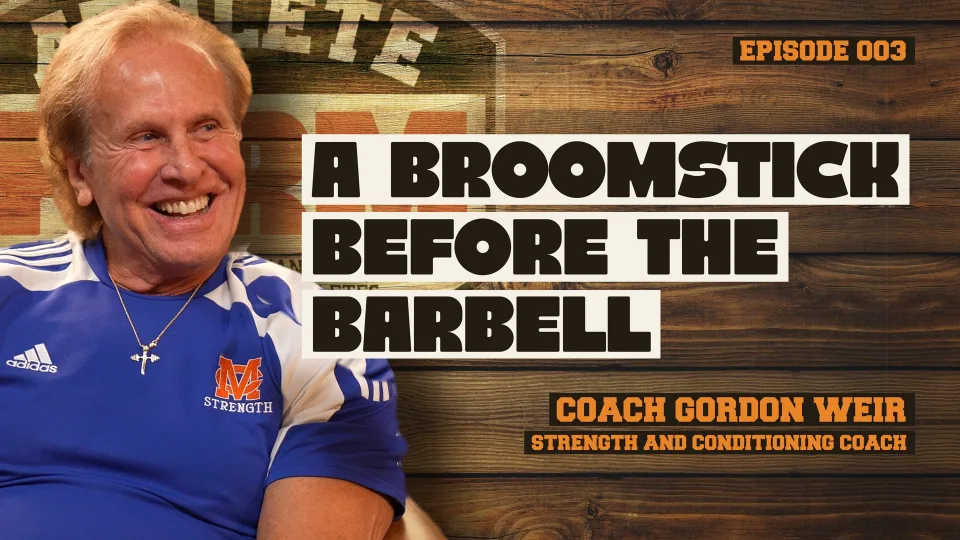
Coach Gordon Weir has trained thousands of athletes across Mississippi and the Southeast, from pros to Hollywood actors, and coached the Mississippi School for the Deaf to three national championships. His rule for parents: no weights until 12 for girls and 13 for boys, and he warns most personal training companies aren’t worth it.
Full transcript
0:03Mike Frascogna: Hey, welcome to Athlete Farm, a parenting almanac for Growing College Athletes. I'm Mike Frascogna III, and today we're going to be talking strength training. I have got one of my coaching mentors here, Gordon Weir, who has trained thousands and thousands of athletes in Mississippi and in the Southeast. He's basically worked out with everybody that's a who's who in Hollywood and bodybuilding and movies, all the major action stars you know he's trained pro athletes he was a pro athlete himself he was a punter and he college athlete as well but gordon has been a strength guru in this area for decades I was first introduced to you we were just talking about it I first started training with you I believe when I was in fourth grade and you
Gordon Weir: were my early students at my father I
0:55Mike Frascogna: was I was way back there And so, you know, I think back to the days of training with you at the Nautilus Center in Maywood Mart. And I'm a fourth grader coming in there. I don't remember there being any other fourth graders in the gym. And I remember for the first year I was with you, I think the only thing that you let me pick up was a broomstick. And so maybe I'm misremembering it, but you tell me. I think we were working on nothing but technique. Right
Gordon Weir: we did technique and basically working, you know, like body movements, body weights type stuff. I've been working in the National Strength and Coaching Association for a long time, and the age now we recommend for kids to start lifting weights, girls at 12, boys at 13. Now, they can go younger if they're doing body weight like sit -ups, push -ups, things like that, because, you know, when you get into gymnastics, I mean, they're doing their body weight, which is a lot more than a lot of weights. So, you know, always the rumor was, well, if you lift weights too young, going to stunt your growth but a lot of that's hogwash that's not going to happen but but you just want to main thing when they're young is teach them the right correct technique teach them sort of about what their goals can be don't want to overhype them and tell them something's not going to happen you know like Arnold Schwarzenegger you know right one year you know but basically trying to get you know just the what we call the nuts and bolts to them first at a young age like with you and all your friends and I tell a lot of people you and a bunch of other kids I took y 'all's group for three or four years up through junior high and then we took y 'all's group and did y 'all's we did your speeds your jumping your you know the 10 yard to 40 yard did all that kind of stuff and then you strength on the bench and squat and then we compared y 'all when y 'all got in the ninth grade against the ninth graders of j and y 'all were the top one for two percentile these kids couldn't believe how could these young guys be just as strong as we are because y 'all were the one the first ones start lifting at a young age yeah
2:51Mike Frascogna: well you were definitely I mean way ahead of the curve in the stuff that you were doing with fourth and fifth graders back then so I mean I consider myself very lucky as I look back to have come across somebody like that they could they could help me I want to you already brought it up and I want to go back and touch on this again because I think maybe the the main question that that gets asked by parents of young athletes right now is the win question. What age do I start my kid in the weight room? And so you said it real quick. You said girls at 12, boys at 13. Give me some of the reasoning behind that. A
Gordon Weir: lot of it depends on the maturity of the kid. Some kids mature a little bit quicker. And, of course, a lot of it is body types. You know, genetics play a big factor. I went to Russia with a bunch of other strength coaches, and that was a great learning experience because what they do over in Russia, they have like Junior Olympics. Of course, back then it was the USSR. And they had all these countries, and they'd take all the best athletes, and they would take them when they were 13, 14 years old. They'd bring them to IMG like you've got here in Florida. And they would take all those kids away from their parents, and they'd basically live in Moscow Sports Academy. It would be like three hours of education, six hours of sports training. But what they went a step farther, the young kids, is they did a lot of genetic testing. which is a step beyond they would measure levers distance from elbow to wrist knee to hip and then they would do they go a step farther they showed us they brought some athletes in they take a look like a little screwdriver and they go into the quad and pull a muscle out of the quad to see where your fast twitch or slow twitch oh gosh that way you could discern what sport they need to go into because you know your levers have a lot to do with what kind of sports you need to be into to so they were a step above because you know all they wanted to care about back then was beating us in the olympics right they didn't have any pro sports and it was very serious business so I learned a lot from them because when I went over there they said that I remember the coach who had all olympic team the strength guy he said you know madigan's you stupid you do all this static stretching said no no no no no must always do dynamic stretching must move but nobody over here did dynamic stretch at that time we didn't know nothing about that right but they were a step up ahead because they were more into research they wanted to win and now you see united states we've completely changed around because sports has gotten somewhat more competitive kids are starting younger ages now right so it's so important to know facts like that so you can teach these parents and get any basically I tell my parents try to give them realistic goes you know like joey can do this or do that and a lot about you can look at genetics whether endomorph you know ectomorph or mesomorph ain't many mesomorphs out there you know people like Like me, you were ectomorphs. We had to work our rear ends off.
5:36Mike Frascogna: Explain what that is, those three body types.
Gordon Weir: Ectomorphs are people who are tall, thin, got long limbs, long legs, and tends to be on the lean side, low body fat. Endomorphs are people like offensive linemen, defensive linemen, wide -waisted, big quads, big legs, thicker arms. Mesomorphs are kids that look like somebody like, you remember when we were kids, we'd see the guys from Ohio State come out there, the linebackers in their necks were like that wide, so wide. They had those huge old neck pads on, just, you know, there's so much muscular. But a lot of kids that are real muscular, that are mesomorphs at a young age, they don't tend to be as tall. So they're a little shorter. So that's why, like I said, the Russians, well, they could pick out, see what kind of, not only what muscle and what kind of body type you were, they could put you into a particular sport that suited you. Like if you were a mesomorph, they'd probably put you into a type of Olympic lifting type sport.
6:27Mike Frascogna: Yeah, right. So everybody didn't just automatically go into travel baseball in Russia. they had other things that they put a bit of baseball I know well yeah they were ahead of us but thank god you did not adopt all their techniques and take a plug out of my quad to determine whether I had fast twitch muscle fiber or not I appreciate you not doing that to me
Gordon Weir: I think you my parents wouldn't like that I don't think I had the equipment to do that yeah
6:52Mike Frascogna: good I'm glad well you called it a screwdriver I'm sure you had one of those laying around I'm glad you didn't try it I don't know that I would have been on board with it so I've got my two youngest kids right now Rocco's in fourth grade and he has done some work in the past little over a year now with an Olympic coach that was just teaching Olympic lifts but essentially just with a bar right and so my observations in in watching him go through it is very very much like it reminds me a lot of the training I did with you when I was in fourth grade watching him go through it for a year the things that I can see is that he's he's able to squat just squat what you think what's the big deal of squatting when I want to watch how he squats and he positions his hips and his butt and his chest and shoulders I go he learned something in the past year explain why that's so important in sports it seems basic oh
Gordon Weir: yeah I mean you're you're basically your strength like so when I was in russia they brought out four athletes from different weight groups and he explains why it's so important for squats he said but the most important muscle you have to work for all athletes is the lower back your lower core because you think about it he said he had back then they didn't have hyper benches so what they I don't know you see those video films when we were school the old exercise gyms where they had the wooden and dowels on the wall yeah yeah and they would get so he brought three guys in and they took their shirts off 181 guy I think 198 into 242 and the first guy got put his foot into the down he did a hyper went all the way down the floor with 225 for 10 reps with the barbell and the weight all the way down and up holy cow and then the next guy did 315 for 10 and the other guy did 365 for 10 which is just insane strength right he said turn around so when they turn around their erector spinal muscle the lower back they're like most bodybuilders when they get the abs all sticking out -huh he said you gotta work the core the back is your center of all your body the strong your back is it's gonna cause your whole body and that's also you know like the guy that I'm trying to remember his name that I went to see his he's louis simmons he's one he's trained more top power if there's an olympic lifters anybody in the united states and he really focuses on lower back strengthening lower back muscles so that's really important for younger kids because once you work that center fulcrum of your body everything else bounces out that's where that's the main part you think about everything you do you bend reach everything comes from the center of the lower body that's the center force that's the fulcrum of your whole body is that lower back so
9:34Mike Frascogna: is it important to balance out those lower back muscles with the the opposite side, which will still be your core and your abs.
Gordon Weir: Or your antagonistic muscles, correct? Right. So a lot of athletes, they're all, like you go to most of these high schools, when I used to do all these high school weight programs for them, I said, y 'all don't even have a hamstring machine. So they'll do SLDs or hamstring stretches. I said, but your problem is, you're supposed to have one and a half, one quad to hamstring ratio. Most kids, I said, all right, you can do 200 pounds on a leg extension, but you can't do a hundred pounds on a leg curl.
10:04Mike Frascogna: They have no hamstrings, right?
Gordon Weir: Yeah, and see, that's why you get a lot of injuries, because you've got a differential in quad and hamstring strength. So that's the key thing is trying to work balance and focus on the muscle more important. So at a younger age, like you're saying with squats, like I had a couple of Russian athletes that worked for me that defected. One of them taught at Jay. His wife in Dasha, she was probably one of the best dominant athletes at Jay we ever had. I mean, she was a genetic freak. And so was Alex. Alex was a decathlete. And Alex got a, after two Olympics, if you don't medal in Russia, you got two choices. You either go work in prison in Siberia, or you go join the military. So they went to, I think it was down at the Pan Am Games, and they defected and came over here. He came to me and wanted a job, so I got him a job. So you can help me with my speed. He already knew all that stuff. But he said, like, same thing that you're doing, you're an Olympic lifter. They learn all Olympic lifts, every one. They start out with a five -pound stick, and every three months. I said, and he said, it was monotonous, but they wanted, it's like brushing their teeth. They wanted to get it so down pat. So once they got 13, they had all the form down. And that's the problem. I see all these Olympic coaches around here, they're teaching all these kids in these schools, doing like, you know, snatching. No, no, no, certain sports don't need all that kind of stuff. You want to do certain exercises depending on the sports. That's another thing you got to be careful of all these coaches. That's one thing with all the years I was at the NSCA, I was on the adolescent board. And we would try to get all these coaches to agree because you always had three different groups. You had the strength guys, you had the powerlifting guys, and you had the Olympic guys. And all three came from different things. Probably the greatest strength coach of all time, he coached Penn State for 10 years, won 10 games every year, and then he went to the Pittsburgh Steelers and won all the Super Bowls. I can't remember his name. He wrote several books. because he was the first PhD strength coach who ever had a PhD. In my mind, of course, as long as I've been around, I can't remember. That's sometimes when you get old, you forget a lot of names. But anyway, he said, what I teach all my athletes is I want a little bit of every program. What's going to be benefiting my program? A little bit of this, a little bit of that. We're not going to go all Olympic. We're not going to go all powerlifting. We're not going to go all bodybuilding. But it's good to mix up like every kid wants to do, bicep. You know how we used to always do pump down the last day of the week because you know it's it's something to it's a reward that's right reward but you know it's like saying I you know I always do my shirts I say you know it's not the type of car you drive the size of bicep you hang out the window so you know and I always teach my kids when I always do our photos you gotta learn how to do your photos that's because when you look back in your album the kids your sons are gonna look at you said dad man your arms and your neck was huge of course I I was always in the back row, so I could always flex my neck. Yeah
12:53Mike Frascogna: you used all your bodybuilding tricks is what you taught everybody. Put your
Gordon Weir: hands underneath your arm and do like that. And, of course, when we were young, we'd ride around the parking lots looking at girls. And you'd roll your window halfway down, and you'd put your arm over the window and make your arm look like it's twice as big. And you'd go, hey, baby, what's going on? So, you know, a lot of that kind of stuff is just for self -esteem and getting fired to do something. But basically working the basics. basics and you know like I said like we're talking about with young kids start real light stuff get all the movements down but then when you get into different sports like you're playing soccer baseball different sports that's probably all these schools now they everybody does the same thing each sport should be have different training totally
13:36Mike Frascogna: different movements and got to be trained differently exactly I'll come back to that in just a second but because you you mentioned it now my my youngest Petra is in in third grade and she's she's a gymnast yeah and this is this is my first rodeo with gymnastics and and seeing that and it's it's a it's a wild sport oh man you gotta be strong and she really worked core a lot of core
Gordon Weir: hip because they got a lot of balance and stuff
14:04Mike Frascogna: yeah it's there's so much balance and there's so much core work that's being worked through that but where where does where does strength training fit in for gymnast because like you said they're They're doing so much with their body weight all the time. Does strength training even fit with gymnasts? How much of it do they do?
Gordon Weir: You know, we used to have the Cornelius Gymnastic Club at our place. And they're over there next to the Y. That's
14:27Mike Frascogna: where she trained. She's with Mario.
Gordon Weir: And Mario and all those guys, Kevin and the three or four brothers. But they were on the Puerto Rico Olympic team. They were really good gymnasts. But a lot of those guys, you know, I mean, gymnastics, I mean, it's core. It's like you see a lot of, I mean, I used to train a lot. I was still training when I was at Mass Central. I mean, I had to do the entire athletic program. Coach Hall came to me and said, all right, Gordon, you're going to do cheerleaders. I said, cheerleaders? Yeah. I don't know nothing about training cheerleaders. So I had to go research it. And, you know, you got your flyers and your base people. And I had to learn all that stuff. And a lot of it was core strength. And, of course, you know, flyers got to be lighters because you can pick them and catch them. But now they're teaching all these girls that are getting into gymnastics are also wanting to be cheerleaders down the road. So you got to learn all the gymnastic moves because they're doing a lot of core stuff they're putting up against the wall that shows up against the wall so they can when they get up so they can balance because if you're wobbling like this you're gonna fall down so right they're teaching a lot of core stuff through the through the you know bleaks and the core of the hips and the lower back so core strength you know gymnastics I've never really had any gymnasts come in to do weights yeah you know most of all because I mean you're doing so much stuff like you always It always amazed me. My dad made me the ring thing where you used to do the bars. I said, that's when they was kids. That's all they had because they didn't have that type of stuff. They did ropes, and they did all the push -ups, chin -ups, and they did those cross bars where they'd jump from side to side. So a lot of people would do what they could work out with.
16:01Mike Frascogna: So what about – talk about boys versus girls in the weight room. and when you're when you're dealing let's say we've gotten past the age threshold of where you would recommend someone starts training 12 for girls 13 for boys so let's say we're above that at this point just above it do you do you train girls differently than you do boys and if so how what do you focus on different yeah
Gordon Weir: basically train a little bit different they're getting course depends on age because if they're still developing and going through puberty and we're gonna do more higher reps okay and of course they're getting depends what sports so if they're doing a lot of soccer they got a little lower body strength running sprinting since sure you know so much sprinting involved in that where you know like basketball it's gonna be different be more jumping type stuff you know explosion type stuff exercise you'll do you know quick jump squats but of lighter weight being more explosive because that's the thing now everybody's really you know because plyometrics got big you know years ago when nobody knew about plyometrics about 20 years ago yeah so that's big with athletes too but girls just a little bit you got to do a little different in there because I I can tell you so I had a girl at mass central I'm not gonna give out any names but she's beautiful and she played softball and she was just had a lot of muscle she's genetic and she came she said coach well I don't I don't want to lift any heavy weight I don't want to get any bigger she said I don't want I don't want to look like a boy -huh so you got to learn certain people you got to learn that train a little bit different so I'll do her high reps because now you look at softball girls they've got so much bigger and stronger it's a whole different ball game
17:39Mike Frascogna: well and you know what you already started I was going to ask you that question at some point anyway it's I mean this applies not just to athletes but even even just I mean women who are working out we're focusing on the athletes but the the idea well I don't want to lift weights I don't want to get bulky like a guy and it's
Gordon Weir: that's not like I tell everybody the story like when I had sandra bullock she was one I had about 15 20 people from time to kill and sandra was trained with with matthew mcconaughey was one of my guys great guy and he hustled us off golf money he didn't tell us he played golf at texas when he played with us after about a month to take all our money but anyway sandra at three months she's never lift weights before really so she started lifting and she came back she said I don't know if I'm gonna do this anymore with you gordon she said I've only I already put on six pounds and I said she said this is the weights are getting me way too muscular I said sandra I said do you shave three times a day she said well no I said were you born in east germany she said no I said your last name's worsen hager she said no I said you haven't put on six I said you probably put a little bit of muscle muscle weighs twice as much as fat yeah and And I said, your appetite's probably gone up a little bit. And I said, but you put on a little muscle, but it's good. I said, because the more muscle you have, the higher your metabolism. That's like I said, all the years I've had the top, I had Monica Brandt two or three times in my body machine. She was on more magazine covers than any other woman ever. She was Miss Olympia figure and fitness. So she was awesome. But girl weightlifters train a little bit different because they're trying to build a little bit of muscle. But girl athletes, there again, it depends what sport You have to vary your training, whether basketball, softball, soccer. And you see, like, most girls right now, they're either doing gymnastics, soccer, and softball seems the biggest sports. Volleyball. And volleyball, yeah, especially for the tall girls, yeah. When I was a J, our girls' softball team, I mean, volleyball team, were dominant. They were really good.
19:38Mike Frascogna: So if you had the parent of, you know, a young teenage girl who's an athlete right now, and you're advising them on how to speak to their daughter about we need you're a competitive athlete we need to be doing some strength training and the parent is worried that their daughter is going to get too bulky or that's what they know their daughter is going to say that how do you how do you tell them to speak to their daughter about that
Gordon Weir: basically you should tell them like there again goes back to genetics but just tell me basically what you're trying to do is get them stronger so they won't get hurt you know building a strength base basically doing plyometrics especially for volleyball because you got a lot of jumping to do quick jumping get on a box doing bounds you know depth jumps things like that and of course because volleyball you really gotta get up spite that's why you know why all the years I was remember the NSCA we go to the conventions every year that's where I met Randy that Donald Chi was was the father of plyometrics and he always asked he but we always have these great little meetings we call it where we all get together and just sort of share brunch like me or shooting ideas with each other and he said what do you think is the best what athlete jumps higher than the other athlete and about everybody in the group said basketball players he said no volleyball players and he said you know my program he said I train all my volleyball off her to jump he said because there's quick jumping fast jumping but you got to be quick off your feet he's saying girl especially volleyball you got to be able to get up and you got to be after you know you got to have side movement you got to have lateral movement you got to have you know be very athletic so basically just plyometrics and just basic strength training like triceps if you're doing overhand surge you got to work your upper shoulder muscles work the girdle you know work all the deltoids you know try to work all the three heads of the shoulder traps so
21:31Mike Frascogna: even all the things you're saying right now breaks down the complexity of the training for sports I mean you talk about there's not just jumping there's different types of jumping there's all these muscles you know that are playing into a spike in volleyball so you know for parents who have decided I need my kid in some strength training Let's assume they don't have access to you. How do they judge whether or not they're with a strength coach that's good, that's worth what they're paying? What do they look for? How do they discern what they're getting?
Gordon Weir: That's very important. That's what I've been telling parents for years. And that's what we did with NSCA when I was on the adolescent board. That's when we came up with these ideas. We were trying to think about what can we do for kids to get proper training because you know you get up to where you what we call a professional level as far as training and sharing ideas but the main thing we want to teach you about nsca we started certified strength trainers problem is there's about three organizations that were they're certified and accredited the problem is there's 142 personal training companies and 90 of them ain't worth it you know matter of fact one of the last one I went to a good friend of mine strength coach jaguars he spoke at the NSCA convention and he said he said I want to show you how bogus these these people call themselves personal trainers are he said my daughter just turned two years old I got 129 dollars here to send into this company my daughter his daughter and he said I sent her name and he said in two weeks she got her personal training certification she was two years old and you gotta lie that because you know you want because I mean when all my people that work for For me, if you were a personal trainer, you had to be the ACSM certified or NSCA, and it's expensive. I mean, they used to call me at the courthouse all the time, these personal training companies. We're going to come in on Saturday and have a personal training certification class. It's going to be $149. Y 'all get $49, and we get $100. And I said, so you're telling me one day somebody's going to be a personal trainer just by going to your class and taking the open book test all day? I said, you've got to be careful. Make sure when you get a trainer, make sure they're certified. Check out the certification. Because a lot of guys, a lot of people want to be trainers, but they want to do it for one hour, two hours a day. Most of your good trainers are full -time trainers.
23:55Mike Frascogna: And tell me again, the reputable organizations.
Gordon Weir: NSCA, ISSA, and ACSEM, American College of Sports Medicine. They've been around longer than anybody, and it's very expensive. it gets because you have to I mean like when we used to have our nsca conventions we have four thousand people would come to take the test only forty percent but there's personal training certification and then there's athletic trainer certification and that's much more difficult because you gotta have a lot more biomechanics involved in that a lot of more legal type stuff you know a lot of stuff that you need to know that I'm gonna train somebody because you know you put your your child and with somebody that didn't know what they're doing talking about getting hurt and that's the key thing is a lot of kids get hurt because their body's in balance they don't know what they're doing and like all the years I've been training athletes I've only had one injury with a kid and so that's one thing is if you you miss it one time that word's gonna get out to everybody whether he hurt my kid he did this or that right so you gotta know what you're doing and you gotta take it a slow pace especially younger kids and the main thing with getting younger people involved with sports is not only to teach them life skills but basically to to teach them how to be competitive, be involved with the team, be part of something. Because there's a lot of kids. I've got a couple kids that I train with right now. They don't play. They're on the team. But they just love being on the team because they belong to something. And they're never going to be able to play, you know, start. But they came and they want to get better. And that's why I tell all these parents, you know, you just want to get bigger. And the key thing it does to all of them, like somebody like you, I mean, when you train, you were a small guy, but you were quick, fast. but you wanted to work you wanted to be better and that's what you want to tell kids you you want to train it's going to encourage them to be better either they're going to be good athletes it's going to help their self -esteem they're going to be better in life because they'll be more competitive and competitive people always do better in the market
25:50Mike Frascogna: yeah all that is completely true I believe all of that is true so let's say again you're you're you're recommending Mending 12 -year -old for girls, 13 -year -old for boys. Parents are looking for a trainer. You're looking for somebody that is certified through an accredited organization. You name the top three. They're all jumbled letters to me in my brain, so I won't try to rename them. But you've got your three main organizations. And then let's say a kid starts training with somebody. The parent's able to find somebody that's got a certification. They begin training. what kind of things can the parent expect in the first month six months year what's realistic and I know it varies wildly you know by athlete but what what are some reasonable goals they should be they just kind of earmarks benchmarks that they should be looking for to know we're going in the right direction what
Gordon Weir: what I do with all my athletes I have a basic base format I use for all my athletes first thing I do is do their body fat find out what the resting metabolism is because the only two things you can control is your intake and your expense rate so once I know that I know how many calories you need because nutrition is another important element to any kind of training because if you don't have proper nutrition no matter what you do yeah
27:16Mike Frascogna: we're going to I'll ask you about nutrition and supplements in a minute it so right right now we're just it's what are they looking for from that strength coach you
Gordon Weir: want somebody that's going to be able to measure your strength levels every month because you're paying somebody you want to see what kind of results you're getting so every month I'll do a summary and I hand it back to the parents and I keep a thing when this kid starts seeing they gain the weight their strength goes up that encourages them and of course you also got to make sure now these junior highs are starting to implement weight programs you don't want to over train the kids but mostly junior high programs don't really do another they might do three exercises three sets of exercises you know it's usually always 10 8 6 or 8 5 5 or you know just sort of basic stuff so a lot of times I try to tell you know parents if you want your kid to be a a top athlete it takes a lot more than just doing that at school because to be the best you got to train more you know only the best to train I mean you know all the athletes I have I mean it's It's four -time training. When I was at Mass Central, all my athletes were there. You know, most schools I went to, when you played football, after football, it was over. It was all year round they had to train. We were doing something all year round. So
28:24Mike Frascogna: what do you, when you're measuring strength and to try to see are they making progress, what are the movements that you focus on? I do bench, squat, and
Gordon Weir: I do a lap pulldown, measure the back strength, and I do grip strength.
28:41Mike Frascogna: Okay. How do you measure grip strength?
Gordon Weir: I got a gripometer type thing with a grip to measure. And I used to have the hammer wrist machine, the way you do it like this. Yeah. Because the two measurements for adults as you get older for longevity is leg strength and grip strength. So those are always good measurements to use. Because that's what the Russians also said. That's what I always stuck back in my mind is what all these guys said because I said these guys are serious about training. and, you know, they wanted to beat us so bad. And he always said, you know, like speed. He was the first one to tell us about speed. He said, you Americans, you don't understand. He said, you have big legs. He said, if you're a sprinter, you must have tiny calves. Cheetah is the fastest animal in the world. Tiny calves. He said, because it's all about ground contact. Less weight you have to pull up, quicker you're going to be. That's why you were so fast. You could move, but you weren't running. And, like, I had the fastest kid ever in the deaf school that I trained. And he was an all -time fast guy, Calvin Smith. My boy beat him every year in Calvin Smith, and it went and gold medal at some, what's that school out there by Belmont. But anyway, he was fast guy every man, now he is anymore. But back then we did a hundred yard, now it's a hundred meters.
29:57Mike Frascogna: And just real quickly, I don't want to go in depth on this, but I want to give you credit for it because it's a cool aspect of your past. You coached football at the Mississippi School for the Deaf and won multiple national championships. We
Gordon Weir: won three national championships, and I got voted twice national coach of the year. Yeah. And we played eight deaf schools and two, three public schools. And we had some athletes. But, see, we only played – we didn't have enough kids. We only had like 17 kids. So – but a lot of people don't realize the huddle was invented by deaf schools, deaf kids, because when they did signs, it had to be in a huddle. So that's when the football huddle came from deaf schools. And people don't realize, like, Ole Miss, the state, and all these schools, back in the 50s and 40s, they'd play school for the deaf. Mississippi, Texas school for the deaf. Because back in the days, the school for the deaf, we'd go all the way up to age 21. Huh, okay. So kids would go to school. So they had to play the deaf schools. In football, if you go back and look at some of these, who they played, they played the deaf school. Well
30:57Mike Frascogna: that's why I always thought that was an interesting part of your background. And sometimes you just glaze over it. But it's a really cool thing that you did. And I was blessed my parents were hard of hearing. So
Gordon Weir: that's why I got into it. And I volunteered to come help them when I was having my business and stuff. And when I left Mass Central, five years of Mass Central, then I went to deaf school for two or three years. And I said, man, you came at a good time. I had some good athletes. I said, it's always good when you've got some good athletes.
31:21Mike Frascogna: Yeah, that masked a lot of problems. So let's go back to you're talking about strength training with younger athletes, talking about kind of advising parents on that. what they should be looking for and you and you already started touching on nutrition all so the I think every parent that has young athletes can you know relate to what are we eating tonight we're we're on the move we're over scheduled we got multiple kids going in multiple different directions in different sports it's it's getting harder to just manage the day -to -day and you know we're spending more time running through chick -fil -a's drive -thru than we probably want to but there's there's probably a full chick -fil -a meal on the floor of my car at any given time of just scraps that
Gordon Weir: the chick -fil -a is a big yeah big very popular that my any kind of fast food is big is popular yeah
32:16Mike Frascogna: and I'm not here to make an argument that this is you know a grade a fuel for for these athletes but what's kind of some practical advice how I mean how would Would you manage it? What are you looking to put in them? You give some general guidance on nutrition.
Gordon Weir: That's what I do. That's my biggest selling point. All my athletes, like I said, I've had 15 first -rounders. Like I said, I told you, I have Walter Payton, Jay Rice, Ben Williams. I go on several guys from Jack State, Valley, of course. I did Valley's weight program. I did a lot of Jack State's weight program. Coach Gordon was there. but I had a lot of athletes, but nutrition was so important. So when I went to them, I said, look, I was the first person in Mississippi to push creatine. Dr. Amada came to me and Dr. Amada invented it up in Memphis. And my good friend, Dan Lott, was strength coach at Memphis state. He said, well, you gotta get on this new creatine stuff. And I started telling him, oh, well that stuff dehydrated. And I said, nah, nah, oh yeah, dehydrated. I said, nah, I don't think so. I was telling everybody, everybody thought I was idiot. Well, same, Coach Weir was way ahead of time because now everybody's on creatine. It's good for your brain. It's good for your heart. But what it does, it brings water into your cell wall. So creatine's very good, but you've got to do small amounts, 5 milligrams to 10 milligrams, depending on body weight. So that is a great supplement for every athlete. Starting at what age? Starting at 13.
33:41Mike Frascogna: So same as weight training? Right, same as weight training. Okay.
Gordon Weir: And, you know, the key thing with kids, when you measure their getting their nutrition down, What I do to all my athletes is being with the NCAA, we cannot tell you exactly what to eat because we're not licensed nutritionists. So what I do is I'll give them a meal plan, and it depends what they're trying to do. If I've got a kid that's thinner, I'm going to make him eat bigger meals because the bigger the meal, the longer it takes to digest, the longer it takes to digest, the more the body's going to store calories. People like me, you were always lean. you know we would always eat you know in body bitters they eat five six eight meals a day because they're trying to stay lean because the more meals you eat it speeds up digestion which helps you burn more fat well you don't want to do that you know if you depends on they're getting back to body type but on the nutrition end so we'll do I'll do a give them a list of all the foods I give them this this is a group this is b group this is c group and for example if a kid is trying to, you know, 3,000 calories to maintain weight. Females, 2,000, 2,200 calories to maintain weight. If every pound of muscle you put on, you got to put on, take in another 2,500 calories of lean, you know, stuff's muscle. You teach these kids, give them a list of all the foods, what to eat, that's what you choose from. Pretty much every morning's breakfast is going to be turkey bacon, oatmeal, you know, and then one day we can fudge a little bit. and then taking the scum in. When y 'all were young, I met all the kids. When I did prep's program and y 'all, I met all the kids and take baby food to school. The headmaster prep got mad at me because all the kids backed into the baby food and jazzed glass jars, and they'd pull them out of the locker, and they'd break on the floor, and the glass would go everywhere. Well, all these kids got baby food in here. I said, well, they're eating between meals trying to keep their weight up.
35:35Mike Frascogna: Is that particularly high -calorie? Is that what it was, I assume?
Gordon Weir: You've got to remember, a lot of kids, is most young kids got high metabolism yeah sure they're most of them are hyper so that's one thing when you do the metabolism when you measure the rest of them then you got an idea okay this kid's metabolism way up here so he's got that much more calories yeah to gain weight so that's why you got to know the basic factors you got to know what the rest of metabolism is and then what exercise I saw how many days you're working out what are you doing and I add all that up and I said let's how many calories you eat today to get your go so you got to have somebody has a little bit of nutrition background into it right of course what I learned from nutrition more than anybody's all the years in bodybuilding bodybuilders are smarter about nutrition more than anybody because they got to be right on they got to be perfect and they got 12 weeks to get right they got rid of all that fat you know and of course it's very strict dieting and when you do that type of stuff you come home and fuss with the wife and kick the dog you're not very good mood so it's tough to you know diet nutrition is very important so that's what tell his parents So I've got all my parents putting their kids on different types of protein. You've got high -carb protein. You've got middle -carb protein. You've got low -carb protein. You've got protein no -carb. Again, it depends what you want your kid to do. So you've got to have high carbs, too, because what carbs do, it helps the kid gain weight. The protein is going to build lean muscle mass. It'll build tissue. But the carbs helps you gain weight and gives you energy. And, of course, every time I go to school to do a program for all these high schools, I'd have all the parents in a huge group, and I'd say, how many of you kids in here drink a glass of water a day? Not one kid raised it. How many of y 'all drink six? Not one kid raised it. How many of y 'all drink four? Not one kid. It got down to about maybe one or two glasses of water a day or drinking Cokes and orange juice and everything but water. So now you've got to retrain them and tell them, hey, water is very good for you. And you can mix that creatine in there with water, you know, also twice a day, preferably before you work out and after you work out, but get to drinking more water stay hydrated that's another big thing because you know like with athletes that was my job as jay and mass central was to make sure our kids stay hydrated so I had them loaded but we started hydrating on wednesday for games friday I may drink a lot of water so you got to teach the kids even at a young age they got easier because they don't want to drink water that's boring to them it's a lot of things just educating these young kids and the parents and when you give them a list of foods they go to the grocery store they buy all that stuff so they'll learn how to eat and when and when these kids start seeing a difference you wouldn't believe all the kids I've got I mean I've got three four kids with me now that were ectomores and they've been me one year they all gave me I've got one kid gained 42 pounds this year another kid gained 33 pounds wow and then and the problem there you know when they're in the gym they work out but in between sets they're overthrowing the baseball I said settle down I know you're hyped for settle down I
38:27Mike Frascogna: always I always think it's funny when parents will They'll make a comment and say, oh, I just don't know what to do. My kid just eats so terrible. And my first thought is, does your kid have a credit card and car keys to go to the store to shop for the house? Because I'm pretty sure they don't. So they're only eating what's in the house. That's not on them. That's somebody else's responsibility. And
Gordon Weir: to feed them right and get them bigger, it's going to cost you more money because, I mean, protein is not cheap anymore. And the other best source of protein, of course, is going to be, you know, fish, turkey, you know, turkey bacon instead of bacon. Of course, bacon tastes better. but yeah you get used to eating turkey bacon a lot of eggs egg whites one year one yellow per five egg whites you get more texture tastes a little bit better the egg whites is the top source of protein and eggs are excellent for you so things like that get kids to re -change your eating habits and once they start seeing results and that's one thing all these parents just bring that so well you know you used to come in my office I had all those photos of all the athletes and bodybuilders on my wall famous people because you know when you're trying to tell your kid what to do about eating right they're not going to pay attention to you my son wouldn't pay attention to me yeah you know when they come see me I was well that guy knows what he's saying he's not my parent he'll listen to me
39:37Mike Frascogna: you're probably saying the exact same thing as their parents maybe it's we talk about it all the time it's just it's coming out of a different face that's and so that face counts the parents never count the well and I guess when you're talking about seeing results you know I think it's true for any athlete when they start seeing results it reinforces the work they're put in makes them want to do more of the work so you get into that positive spiral that's right but you with the younger athletes the that idea of them not starting weight training until after puberty to me that may be the most practical reason right there is that you can work out all you want pre -puberty you're not gonna pack any muscle on your body can't do it and so you're not going to get into a positive feedback spiral you're going to keep working out and you're just not going to see a gain because your body's not ready to do that yet it's not necessarily that it's
Gordon Weir: at younger age yeah
40:35Mike Frascogna: I think I see that more as a practical issue of to the athlete because even like I mentioned my son rocco doing some power lifting over the past year he thought it was fun he was he was interested in it and and I I definitely saw it have positive impacts on some body positioning and form like squatting. But he was going because he was having fun with some of his buddies. It was a little different. They were getting incrementally stronger. It wasn't going to be a big leap. But it's kind of abstract at that age to say, I'm really fired up that my squat form has improved so much. I mean, nobody cares about that. Now, what about if my biceps got bigger? Oh, well, now I'm in a positive mood. Yeah, I like that. I want to
Gordon Weir: do that. Well, I try to tell them, I say, look, nobody likes to squat. Squat is the hardest exercise. I say, when I go everywhere I used to go, you know, I'm 74 years old now, and up to age 68, I was benching 365. I've always been. I'm not a real big guy. I got about 260. But I've always been a lean type build. But every athlete, I don't know where you go, what's the first thing a kid says? How much you bench? And they ask you how much you squat, how much you curve. So I always had to bench because, you know, I always said, look, I'm older than you. I could be your grandpa, and I could still kick your little rear end. You know, so you got to put up or they're not going to listen to you. It's like my best friend who gave me this cross right here, Anthony Clark, the strongest man in the world, I brought him here on several occasions, and he was the first man ever to bench press 800 pounds and had the world squat record. Now that the record was he did 810, now the world bench press record is 1,401. that's how much sports has changed in 20 years he had squat record at 12 10 it's 30 13 50 now but people are benching more than they squat which is unheard of you know I mean just amazing but when he's when he's and and anthony was kind of guy that he was just a short stocky kid from the philippines and he came over here and he was nobody liked him he was so he got into weights that was his thing to do to get respect yeah so he got bigger and stronger and then he started getting respect yeah so
42:48Mike Frascogna: you mentioned something about how the the world records have increased and then you look at like the NFL combine and you look at what guys are doing in the NFL combine and they're there they're you know leaping and running and pressing 225 for reps just you know like like we haven't seen before, and they're doing it many times in bigger vehicles. You know, look at the size of defensive backs now, what they used to be, and defensive linemen. I mean, it's such a leap forward of what it was 20 years ago. How do you analyze that? Are we doing something right as a country, as a society, in the way that we're training and preparing? Or what do you attribute it to? A
Gordon Weir: lot of it's because, you know, more people are training now at a younger ages. Weight training is getting more popular. Strength training is getting all these other forms of strength. I worked several NFL combines. I went to API. Back then it was Mark Vesta who was the number one trainer in the world. And then we also went to Jim Vick in L.A. that trained all players in L.A. And I went to his place, and we got to work. And the year I was there, I got to have a – I had a little group of eight guys, And I had a quarterback at Boise State that coaches the Saints. He's probably going to get fired because he's not doing it, but he had the best. He was 32 and 1 at Boise State, played quarterback for Boise State. Him and I had him and Nick Flores, who was the quarterback at the Eagles, won Super Bowl. Had both those guys in my group, and had a tight end for Sal Klein and another running back for Boise. But had all these guys in groups here, but they start training these guys. and they get after 12 weeks before the combine and train and they're these agents are paying big money I used to have a lot of agents pay and Paul would help me and Paul we would train a lot of these athletes and it's they're getting more into strength and they're learning all these new technology areas and there's so much more stuff that you can do now you know like speed trains got big like you know when I mean you got here and your dad me helped and it's got you started training Randy Smythe the number one guy and when I'd be at the the clinics all these strength coaches thought he was crazy look at that guy look at those what what run parachutes what do you want to run the parachute you know what are those little squares you're gonna run in what is that all about that's stupid you're born you're either fast or not fast he was the way he had his time he was training all the baseball players in japan in japan baseball is huge he started training all olympic teams well he came to me and I started talking to him and feeling him out I said can you really get somebody faster he said oh yeah we can It can get a lot faster. And we started talking and we'd start brainstorming. And he said, a matter of fact, I fixed to go, Jimmy Johnson's talking to me, but he wants me to come train the Cowboys. So the two years he helped the Cowboys, he went back to back Super Bowls. So the coaches didn't think he was so stupid anymore. That's right. There again, he was the head of the game. He was technology -wise. It really exploded then. And that's why a lot of these athletes, like Russia was always a little bit ahead of us because they were putting much more technology and training into their athletes. athletes and now you like you know you go to img I've got a couple of my kids I train now they're at img and I asked my I said what's your schedule like okay he said well we go junior high we go three hours in the morning and the high school train the afternoon we train the morning and then we do four four hours of training and four hours of education so it's a balance but still it's four hours how many schools do four hours of training they'll have one hour in the the morning to come in for where they go in for you know like red light therapy world poo all this really nice stuff guys do yeah yeah that's nice you know like our guys master coach benny our trainer man he's always gonna get your pack of ice and shut up put it on your knee you'll be fine you know just completely different you know but they it's it's the technology's changed and people are learning more because I mean it's so competitive people are bigger stronger so you got to be you got to be strong that's why it's everything you know all sports is getting especially now with the nil money involved everybody wants part of that that money so you're gonna see people training even more to get their kids but it gets to be where we're pushing stuff a little bit too far sometimes you know these young kids and I tell most kids that train be the best you can be competitive be part of a team you know you'll never forget being on that high school team, you know? So that's what I tell everybody, you know, like I was very lucky at Mass Central, went to championship every year. I don't get, you know, of course, I'll always say Alpenault would beat us in the championship game. He finally beat them, then we got upset in the championship game. So, you know, it's always a bigger guy, but you know, I'll never forget those experiences. I got a national, you know, won a state championship in 2000 with Mass Central, with Coach Justice. And we had six players on that team playing in the NFL. Yeah, that was an amazing team. You don't see many teams like that. I mean, you helped cover it, did some filming on that. I mean, you came to the gym, we did some filming on
47:38Mike Frascogna: that team. That was a special team.
Gordon Weir: Oh, yeah? So
47:42Mike Frascogna: you mentioned a minute ago about getting into more kind of the philosophy of sports, of it's important to be part of a team, and, you know, why do you do this? There's long -term health to an individual or benefits to the development of an individual just as a person. as you know a competitive person moving forward whether it's as a husband a father you know an employee just having been involved in sports and understand that understand the discipline of training one of one of the things that I I think I I took for granted training with you early on but have have realized it later in life is that you know there's a lot of people that have never been in a weight room before and are somewhat intimidated by weight rooms and so I think that until they shy away from that I don't I don't understand it it's there's there's a certain culture in weight rooms that's different and sometimes really fun and sometimes obnoxious but it's an interesting culture but being able to walk into a right weight room and just kind of look around and go I know what everything is like I'm comfortable here I know how to work in this environment I think that that's maybe something that's important for for parents that are looking to start their kids into strength training, it's a long -term benefit. You're going to get them comfortable in an environment that's really going to serve them well the rest of their lives. Forget about what it's going to do in sports. Obvious benefits there. But you're also somebody that you've been in fitness your whole life. You're in your 70s now. You're still dedicated to fitness. Talk about just that aspect of you're trying to give your son or daughter or something that's going to be an important life skill, just the skill of being in a weight room.
Gordon Weir: Right. Definitely it's lifestyle. You know, that's what I tell people. You know, it should become a habit. You know, I'm 74 years old, and I train five days a week. And a lot of times my joints say no, but I still got to do it. I know I got to do it. And thank the Lord for peptides. The peptides have really helped me a lot of things. And, of course, you know, that's been there. I've been doing those three years. and that's going to be the next big thing coming now technology wise because you know it's another thing to help athletes train get past certain especially you know like the for joints and cartilage and tissue and instead of doing you know and now I try to teach a lot of these athletes the only thing I'd be careful with a lot of kids will want to try to use other things that they should be used to get bigger and stronger right you know using steroids I try to tell the kids I said don't do that if you do that you're taking a shortcut but you're also a lot more susceptible to injuries and tearing up stuff right you know kids that's the one thing the only bad thing about in the weight room you got to be careful who your kids get around so I always explain to my kids because you won't believe all the years I've been training how many parents have come to me hey man what kind of steroids can I get for my kid I said I don't do that man yeah I'm not putting my reputation on the line so what you got to teach me you can get bigger you might not be as big but you can get stronger and better by doing like eating a lot of protein taking taking creatine, eating right, and getting in the weight room and being stiff. But it's just going to help you to be a healthier lifestyle and be more fitter. Because, like I said, I'm 74, and I'm still about 11%. I used to be 8 % body fat, but I've still got pretty low body fat. And I've still got my hair. You do. You've always had the great hair. You've been able to maintain that. You didn't teach me that trick. I'm starting to get thin. That's all that genetic thing. Yeah. But it's just a thing about lifestyle change. And once you stay in that shape, you're going to live longer and longevity. That's one thing. I'm big into regenerative medicine. I've learned. I went down and met with Gary Brekka. It was a big time. Met with him. I went to some regenerative doctors trying to learn more stuff. Because, you know, they've already got research now. It's unbelievable stuff. So there's going to be some stuff coming up for athletes here in the future where we can train longer and be better, you know, less injury prone. But that's the main thing you've got to watch for a lot of young kids is try to tell them, don't take the shortcut. Yeah. You know, good supplementation, get in the weight room, get in the good training. Do your weights at school, but just remember that small muscle groups, you should always do nine sets per body part. Big muscle groups, you go up to 12. So if you're only doing three at school, if you're doing the training, you're allowed to do six more sets in that environment. And then, you know, so basically that's why you want to get somebody who's going to try to do the same thing. You don't want to repeat stuff and do over -train the kid because when kids are young, they already got a high metabolism. If you over -train, they're going to break down more.
52:18Mike Frascogna: I'm glad you brought that up. That's actually a really important point, and I want to hit that a little bit harder because I always ask you earlier, you've got a kid that's training at school. To some degree, whether it's great training or it's not, it's some volume of training. Then the parent says, well, I want more than that, and I'm going to come to Gordon or I'm going to come to some other certified strength coach. There is too much. There is such a thing as overtraining, and how does the parent measure what did they already get with how much more can I load the wagon for them and you just kind of gave a little bit of guidance and that was major major body groupings I assume that's you know legs chest back you can do 12 sets 12 total sets and for minor muscle groups it's nine sets right
Gordon Weir: and they're getting and you're looking at volume and load of course that volume of course versus reps, load is weight. And then, of course, now people increase speeds also. You have speed rep days. But, again, that's another new thing that's come around in the last 10 years is speed. That's why bands are so – that's what Anthony Clark told me years ago. He said you need to do, like, speed stuff. Like, when you go to the NFL for combine, that's what we work with all our players on the bench. They got to do 225, and they don't care how you do it. You just got to be able to bounce out of it, and they bounce the heck out of it. And they use boards, and that's one thing I use all the time. I use big boards and small boards. because probably most kids bench and bounce off the chest, so they're not getting the full range of motion. So when they get into heavy weight, that strength curve right there is real weak. They use momentum to get there. When you get more weight, you get stuck there. So you teach them all this kind of stuff. But so speed reps help like that. That's what they do to combine because they're trying to bounce off that chest.
54:00Mike Frascogna: So I'm trying to – this is all really good stuff, but it's also kind of complicated unless you're really following it, of how does the parent discern how much extra they can do? Because you brought up great points. Not all reps are the same. You've got strength reps, you've got speed reps. I mean, you've got all kinds of different training. So give them maybe a practical kind of tool to measure how much is going on.
Gordon Weir: Yeah, ask them to tell the parents, to tell their kids, let them know how many if they're getting with a trainer, what is their program at school, what are they doing. and give them an outliner that way they'll bring it to me because you know I've been doing this for so long and there's always been a jealousy factor because you know I tell my kids I said look do what your coach tell you because you're part of the team all I'm doing is trying to get a little bit better I always tell this coaches look I'm here to help your guys be better right I'm not trying here to take your place but you know you don't have the time you got a 60 kids in an hour time you got 10 racks now now when I was at Mass Central I had 28 racks and I could put four kids in a rack well I excuse right here they got eight or ten racks they got 60 kids well yeah squat day how you gonna get everybody in there you might you know get a half you know workouts any right and time you do your stretching and get away from you got about 30 to 45 minutes work after you gotta get a class right so they don't get a full workout so man there's known what their workload is at school and then I was to the kids what everybody they come to mass what'd you do at school today how many reps you do how many sets that way I know what kind of volume they need to do you know how many you know what load they need to do and I keep outlining all my kids what percentage they're at and we have cycles we'll do like what we'll do the russian cycle what we'll do for strength to help them get on the top of their bench because a lot of schools will bench but do cycles but they'll do it's always like pretty much a lot of schools are still doing you know bigger stronger faster which is yeah really so old and worn out
56:01Mike Frascogna: it's 40 years old at this point and
Gordon Weir: the guy invented it was a hammer thrower from sweden and they got bought by sports psychologists took over and just changed up a little bit yeah but you got to change up different but you just gotta let tell the parent to ask tell the kid to bring a copy or let you know what he's doing at school and then when you go to a trainer that way That way the trainer will know what he needs to do to get you to your maximum benefit. So that helps me because that's why I always ask all my kids because a lot of times coaches, they'd say, well, you're going over to Gordon Weir. And I said, no, do what the coach tells you to because that's the most important thing. What I'm going to do is add a little bit on top of that. And there again, because a lot of days they won't even lift.
56:42Mike Frascogna: Well, that's helpful. That's an excellent point for parents to be able to look at. This has been a fun conversation for me, getting to talk to you again and so thank you for being here and thank you even further back for getting me started on strength training when I was in fourth grade which really has set off kind of a a lifelong love of the gym and being in there and so I can attribute that to you and tell you thank you for that well
Gordon Weir: I can attribute a lot to you too because I always use an example a lot of my kids I had a kid that went to jay was not a very big kid and I said he He went to play at Millsaps, and he got with one of my friends, a speed guy, and he's a real Rudy. I said, he went to Notre Dame from Millsaps with Jay and played at Notre Dame and got to play his senior year and got to play, you know. I said, his junior year, he had to be the scout guy. Probably got beat up some a little bit. Well
57:37Mike Frascogna: look, the fact that I even got to be there was an honor. it was a great honor. Just being there, you know, playing in games is surreal. And thank you for being part of that and helping me along that path. I mean, it was a life -changing experience, and I still benefit from it to this day. So I appreciate that very much.
Gordon Weir: It's been a blessing all my life. That's what the Lord put me down here to do, because I enjoy working with kids. That's my passion.
58:00Mike Frascogna: You're very good at it. Everybody, thank you. My guest has been Gordon Weir today, a lifelong friend of mine and one of my original strength coach back when I was in fourth grade. made appreciate you joining us today on Athlete Farm I also appreciate you not taking a plug out of my quad like the russians did to see if I had fast twitch muscle fiber I didn't know that I appreciated that until this
Gordon Weir: conversation we know now you do have but I'm
58:25Mike Frascogna: glad we didn't find out that way and I appreciate you not doing that to me when I was in fourth grade opportunity yeah absolutely thank you gordon thank you for everybody joining us look forward to seeing you on the next episode.
Transcribed automatically from the studio recording. Times are where each question starts in the full episode.