Episode 007
Dr. Doug Tucker
Interventional Spine and Pain Physician
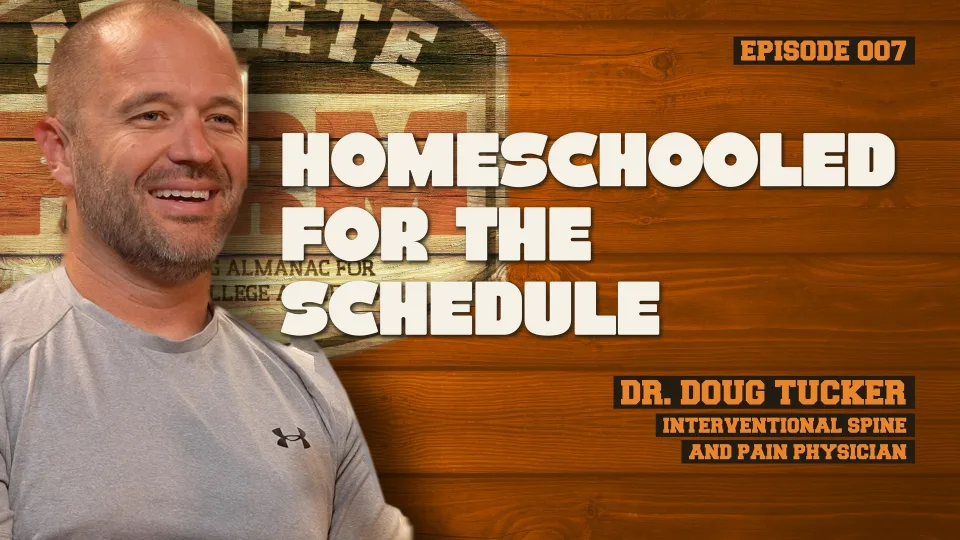
Dr. Doug Tucker is a spine physician with an MBA who runs offshore regenerative and longevity clinics. He homeschools his four young athletes to free up their schedules, had his son lifting weights at seven, and argues overtraining is mostly a myth: kids can handle more than we think.
Full transcript
0:00Mike Frascogna: Hey, welcome back to Athlete Farm, your parenting almanac for growing college athletes. I'm Mike Frascogna III, and today I've got my friend Dr. Doug Tucker here with me. Dr. Tucker is a very progressive physician. He'll tell you about his practice here in a moment and the interesting things that he's doing and how it applies to youth sports. We're also personal friends. We coach our sons in flag football together on the Raptors football team. Our daughters are also gymnasts who compete with and against one another at times, but they're good friends. They're kind of inseparable. To some degree, we're on this youth sports parenting journey in parallel with one another, and we compare notes quite frequently. I appreciate you being here.
Doug Tucker: Yes. No, thank you for having me.
0:50Mike Frascogna: Let's start with this. I do want to start, first of all, with, let's just do your family dynamics first. So you and Lauren, tell me about your four kids' ages, what sports they compete in. What are you all into?
Doug Tucker: Yeah, thank you. So I'm both from Louisiana. I'm from South Louisiana. My wife is from North Louisiana. I'm an undergraduate engineer in biological engineering and went through medical training. Medical training is what brought us to Mississippi. My conventional training is in interventional spine and pain management. My wife, Lauren, is a pediatrician. We had our first son, who is now just turned 14 when we were interns. So life had started pretty quickly for us once we moved to Mississippi. We now have four children. They're 14, 12, 10, and 9. That's three boys. The youngest is the daughter. And by the time we got done training and had the opportunity to move anywhere we wanted to, they had gotten pretty ingrained in everything that they were interested in and involved in. So moving at that point didn't really seem practical. So we're now Mississippians, and we're happy to be here, you know. So the kids, they're all in a little bit different activities. The oldest is football and baseball are his two primary team sports. He also weight lifts. He does that fairly competitively. All three of the boys lift. But the second son, my 12-year-old, plays baseball and tennis are his two primary sports. And then he also, he has competed in a weightlifting competition before. All three of them have. My youngest is 10. Dawson, who's the same age as Rocco, plays flag football with the Raptors. And he also played tackle
2:43Mike Frascogna: football this year too. So he got introduced to that. He
Doug Tucker: was going to leave the family, he declared, if he was not allowed to play tackle football this year. So he likes football and baseball. He plays as well. He likes baseball as well. He's been lifting for several years too. And then Denton, the youngest, is gymnastics and soccer. So they're all pretty time-consuming activities. But, you know, similar to your family, it's something that we see a lot of things positive for them through sports. But it's more than just their individual activity. It has become kind of a family, you know. And I think that's true for an increasing number of families now where it's no longer dropping the kids off at practice. But it's it's more of an activity that we all enjoy together. So
3:31Mike Frascogna: yeah, clearly, you know, your y'all's world kind of orbits the sports schedule of the kids. Ours does as well. And just for the viewers, so they know, your two youngest that are with mine, Dawson and Denton, these are really good athletes. This is not just, yeah, we play sports. No, y'all, y'all play sports at a high level. These are excellent athletes. And so, you know, you and Lauren are doing something correctly because I get to see those two up close and they are both special athletes. Tell me a little bit about one of the other unique things that y'all do. You're both physicians, but you homeschool your kids. So tell me about the advantages of homeschooling when it comes to sports. And then also that there's some disadvantages. So how how did y'all come to that conclusion? And how are you navigating it? Yeah, so
Doug Tucker: homeschooling for us came early because we did have the four close together. And it was more there are academic advantages to it that we could deviate and spend the rest of this time talking about the advantages to homeschooling from an academic perspective. But to be frank, the initial appeal of homeschooling was the flexibility in the schedule. We had the four children even before my oldest started kindergarten and he went to kindergarten and first grade, first grade at a traditional school. And it became just very apparent very quickly that if we wanted to vary the exposures and increase the number of things that they were involved in, it was going to be very difficult if you started with a baseline of 40 hours per week in a traditional school setting. So it was unappealing. And I've always been one that would pursue kind of what I thought was best path, even if it was an unusual or difficult path, perhaps. But it was initially because of the flexibility of the schedule. That was the appeal of homeschooling. So they did attend a hybrid school for a couple years. We didn't jump straight from 40 hours a week to 100% homeschool. We were in a hybrid academic environment for a couple years where they were on campus twice a week and then home three days a week. And it was better. It was a good school. But still, we were then still bound to an academic calendar. We still had grade-based learning. We still had a lot of the academic things that I would prefer in homeschool. They were still disadvantages by the hybrid environment. So they're now fully homeschooled, all four of them. Again, the advantages are the flexibility of the calendar for us. These are the advantages I see, of course. The flexibility of the calendar, the increased opportunity to vary the exposure for them, and then the academic things where we don't have grade-based learning. We don't have. I don't like GPAs. I think they encourage risk aversion, these sort of things. So some of the academic principles that we can build in for them the way we want to. Lauren is home. She's not practicing as a pediatrician, and she hasn't been for a couple years. She's the primary educator. You know, I'm biased towards that, but she is an excellent student, of course. Like, she was always very successful at every level of school she ever participated in. So to have her not just teach the material, but define what being a student looks like is a pretty unique opportunity for our kids. And then it also, you know, fits some higher reaching goals. But the way sports, you know, it. All of our kids play team sports, okay? And when you're picking sports, it's not just binary where it's sports or no sports. I mean, to me, a big differentiator is whether it's a team sport or more of a group sport or an individual sport. And for example, we try to make the decision. Our kids are all close together. So when they all get on competitive teams, the calendars start to get very difficult. And I will go through some examples of that. But, you know, if we had one or two more children, it would be impossible, you know? And we would immediately move to sports like jujitsu or swim team or tennis, or there's a lot of excellent sports teams where they could all be part of the same practice environment. As soon as you move into an individual age-based team, that team now has its own calendar and schedule. And it becomes difficult to get everything done. But for us, we're able to do a lot of the individual work that they would like to do. So for us, weightlifting is one of those. If we were to get out of school at 3 p.m. every day and then jump into their team schedules, there would be no space for weightlifting. And they've been lifting with an Olympic-style weightlifting coach. Rocco's lifted as well. And they've been doing that now for four years, I think. So my youngest son started lifting. He was seven years old, you know? And the opportunity to lift in a controlled environment with a good instructor four days a week would not be possible if they were in school. And then, you know, they all play, all the boys play baseball. So how do you have time for, they all pitch with a pitching coach, they all hit with a hitting coach, they, you know, go to catching individual, all this stuff that you can put into their calendar because of the flexibility we have academically. So they spend, they spend four hours a day, four days a week doing their coursework. And to say it's enough is an understatement. I mean, it's more than enough. I mean, they are at or above every academic requirement they should be for age. And it's just knocking that out in a pretty concentrated and efficient environment, allowing them to do more, including just be a kid. So everything that they are involved in, they still have more time that is unstructured time, which is also important to me. They have more unstructured time in their week than most kids their age, even given the amount of extracurricular and sports participation they currently take on. You know, our daughters, she's nine. She is in the gym, an average of 17 to 19 hours per week, given team practices and individual lessons and these sort of things. And there's no, it's hard to do it. You Petra's right now and your daughter is still doing school and gymnastics, which is amazing. But Denton will get home and if she's tired, she sleeps in, you know, not a big deal, you know, like we'll catch up. So I know that's a little bit rambling, but the academic advantages were not the primary draw. It was the schedule flexibility. And then as I got more into their education, as they were getting older, the academic appeal of homeschool pulled us out of even the hybrid environment and then just allowing us to build more. So the disadvantages, of course, is they don't have natural team-based sports, right? So when they play football, when they play baseball, and this is going to be local to where everyone lives, but Mississippi will not be surprising to someone hearing this, that it's not from Mississippi is way behind in extracurricular opportunities for kids that are not in traditional school environments. So right now we have a lot of difficulty carving paths out for them as they get older to play team-based sports. Again, we're in team-based sports. If we were in individual sports, you know, we'd never consider going to school. In Mississippi, we don't have easy opportunities to play either in a public school where you live in the district or in private school based on our private school regulatory body. I'm working on paths for them, and there's paths for it. It's just not easy. I mean, even I'm from Louisiana, and Louisiana is not necessarily the worldwide leader in progressive thought. But at least this component is much more straightforward in Louisiana, You can participate in extracurriculars in almost any capacity you choose to. So where we live, that is a difficulty. And one of the options is moving. You know, it's if we get down to the point where we're either going to play at a school or homeschool, and if we have to leave to homeschool and play at a school, I'm tempted. So
12:07Mike Frascogna: yeah. Well, you know, talking to you has, you've probably done more than anybody I've ever spoken to to convince me I need to take a look at homeschooling. You know, I had always just already crossed that bridge in my mind, said, no, it's not something, you know, I wouldn't homeschool. I, we wouldn't do that. But it was the argument that you made to me about controlling the efficiency of schedule. And when you said that to me, I started paying attention to what are my kids doing at any given point during the day. And if I didn't, if I didn't love what they're doing, I'm thinking, I just want to script it out. I want to script that out. And you start seeing how that day could just compress at school and go, yeah, we're going to do all the things we need to do. And man, we have a lot of time. We went from being slammed and struggling to get everything done because you don't get out of school till three o'clock. And, you know, we'd like to be done by a reasonable hour, you know, so you have family time. But so there's, there's not much time to do your sports. But boy, if you could condense that school day, man, you can get, you can get all kinds of things done.
Doug Tucker: Yeah. Not to hijack the intent of the podcast, but the educational system was not designed for the efficiency of the student. I mean, it's, obviously a societal need for the purpose of childcare. but it's not designed in order to maximize the academic potential of any individual kid. Now, there's a lot of schools that do the best they can. but my Mac is Friday. Today's Friday. My kids don't go to school on Friday, right? Like they're off 100% of Fridays, unless they had something that they didn't get to because they didn't get there, but their standard Friday, they're off. I mean, they're running in the woods right now, you know, like they're every single Friday and then they'll, you know, they got weightlifting in two hours, you know, but, anyway, so it also fits, yeah, not to go on that tangent, but it, it has been, it has been a very good thing for us. Now, my oldest son is now in eighth grade. and you can, you can find any youth sports, participation at the highest level you want in any sport you want prior to high school. and we are getting to this point now where, team-based sports are going to be difficult to facilitate outside of a school, at least in Mississippi. So, I mean, my thought, part of my thought with homeschooling them anyway, is they're going to be holdbacks. So they're, he's going to, if he was going to go to school next year, he would repeat eighth grade. All my kids will hold back. that's another bias I have personally. I do not see a disadvantage in holding back a kid.
14:42Mike Frascogna: That, and that's allowing them to basically graduate at one year older than they would have. Correct.
Doug Tucker: So for sports, I mean, there's sports and academics, you know, it's fortunate or unfortunate. There's nothing that's objective about the evaluation of a kid. It's all relative to your peers. Right. And that's true academically. A GPA doesn't tell you much unless you compare it to the kids next to them, the SAT, the ACT. These are all comparative assessments that place your child relative to their peers. And that's true. Even if we're going to stick with gymnastics and college gymnastics, it's not an objective measure of a gymnast. It's how are they relative to their peers in that class trying to compete for those scholarship spots at the time. And are they more or less likely to be competitive a year later? I mean, that's the basic question, both academically, both personally, emotionally. you know, the, the primary disadvantage to holding back after they've started school is separation from peer groups. But, you know, another advantage of homeschooling is we're not too worried about that. That's right. So their peer group stays the same.
15:50Mike Frascogna: So, if somebody is considering, whether or not to hold their kid back, your answer is basically a blanket. Yes.
Doug Tucker: I do not see many disadvantages. I mean, the, the typical reasons that you will hear that are the standard responses. Why you should not is they'll either be academically bored, right? Like they already, maybe they will run into some sort of almost behavioral issue because they're not challenged in school if they're held back. or they do have a peer group that they've known forever and you're going to separate them from that peer group. Those are two very common oppositions to it, but you can avoid those, especially in a homeschool environment. So our intention would be to hold them back, but still our curriculum will be as aggressive as they can pursue, you know? I mean, if they can learn college level math and then as a sophomore, they're going to do that, you know, right? But we're going to graduate them and, and you can always catch up. That's the other part too. If you wanted to step on college campus as an academic sophomore, you could certainly do that. Even if you had spent an extra year in high school, right? So, but yeah, I would almost the, my bias would be to try to come up with a good reason to continue them at the normal pace, you know, and Mississippi too. You can't just blanket hold back a kid that's in the public school system. You can't just make that decision as a parent, which is reasonable because it's an increased, you know, cost burden for every child.
17:14Mike Frascogna: I generally agree with you though, on, on holding them back and allowing them to mature a bit more before, before graduation. Again, why? What am I racing towards? What's the disadvantage? Especially
Doug Tucker: if you can take correspondence courses, you're getting college credits. I mean, I, my goal, if they homeschool all the way through would be for all of them to graduate with an associate's degree, graduate high school with an associate's degree from a community college. All
17:38Mike Frascogna: right. Let me switch gears a little bit. Cause you've already brought up, how much weight lifting is, is part of, your, your three boys right now. I don't believe you've started Denton. She
Doug Tucker: has a couple of times, but not
17:50Mike Frascogna: not anything serious yet. So as a, as a physician, as a medical doctor, hot topic question amongst parents, well, when should my kid start to weight lift? Cause is that, well, I don't want to stump their growth. That's the very first thing. Sorry. So how do you, how do you, how do you respond to that? Well, in the, first of all
Doug Tucker: I guess you give you 30 seconds of who I am as a doctor, right? Yeah, please do. Cause we haven't covered that. So my training is an interventional spine and pain management. I have, and I still do that. We have kind of a hybrid medical practice that would take a long time to explain. but that's my primary medical training. And about five years ago, I got introduced to an offshore medical clinic where I went to be a regenerative medicine provider for the spine. That's how I got introduced. And over the last five years, we've been increasingly, I've personally been increasingly involved and I'm now the primary operator of this clinic. We have one in Roatan, Honduras, one in the Bahamas, and we still do regenerative medicine, which is advanced biologic treatment methods for acute and chronic tissue injury. But we've gotten in the last three years heavily into, health optimization, longevity, performance improvement, including cell and gene therapy. so I've spent a lot of time mentally and from a bandwidth standpoint, kind of in the, the performance optimization and the health optimization longevity. So that's my medical background. Okay. Now, none of that directly plays into, childhood weightlifting, but I am more aggressive in most development avenues. I think for the most part, we're a little passive in what we expect to be possible. Okay. But the hard recommendation when we were growing up, right, was it was an if then statement. If you lift pre-puberty or before the growth plates are closing that you're going to stunt your growth. I mean, that's what I grew up knowing that to be true or thinking that was true. but it's no longer just me saying that now. I mean, the formal position of the American Academy of Pediatrics, which my wife is a pediatrician. So when, when we, when I wanted my children to start weightlifting, my oldest was 10 and he's a bigger bodied kid. he's a big kid. So I wanted them to start lifting. Well, that had my other son, my youngest son, who was only seven and he wasn't going to be left out. Like he wanted to go. So we had to be pretty intentional. Like is seven too young? Like seven's pretty young to be lifting, but the official position of the American Academy of Pediatrics has changed and is no longer just neutral on weightlifting, strength training. It actually, the, the organization supports it and promotes it. that doesn't mean you let them lift unsupervised, but you shouldn't have an adult lifting that doesn't know what they're
20:39Mike Frascogna: doing. It's, it's not neutral on it at what age or specifically do they define that children?
Doug Tucker: I haven't said, well, maybe it does. And I, I'm unaware of it. So I don't want to say that it does not, but I have not seen a definition on age, but it's definitely pre puberty children that are supported. Like it supports weightlifting for pre puberty children. Pre
20:58Mike Frascogna: puberty that, and that was the key I was going to ask next is at least as that as the line of demarcation. Pre puberty weight, weight training
Doug Tucker: supported by the American Academy of Pediatrics. Yes. and it actually, good evidence in injury prevention. Okay. Now when you're left pre puberty, you, you don't typically expect muscular hypertrophy, right? You can get stronger and you do see some hypertrophy. I mean, kids can still develop muscles even when they're young, but hypertrophy, like you would expect in a 18 year old is not anticipated in an 11 year old, but you certainly get stronger through neuroplasticity. I mean, you get better at recruiting muscles across a movement. So the more you train a movement, you will get stronger from neural recruitment of muscle fibers across that movement, but the muscles will get stronger in a way that will prevent. It's very helpful in injury prevention. but that's not, we don't do it just for injury prevention. I mean, my kids lift aggressively. I mean, I, they lift hard and I have them on a, or allow them to, access a pretty aggressive supplement program, which is going to be my next question in a minute. So, I mean, they're lifting on purpose to get stronger. We're not just out there trying to prevent injury, you know, and my 13 year old is a 300 pound back squat, you know, and like, he's, he's a, they're strong. I mean, this is my 10 year old strong. so we're, I'm personally aggressive towards it. I think it's great. If we had to stop all activities and do one for the boys, they would lift. Really? That would be the one. Why
22:29Mike Frascogna: why, why is it that you put that much value on it?
Doug Tucker: I just like the physical difficulty of it and the discipline that is required from it. So if I were to take character traits that I expect sports or, or preparing for sports to develop, you know, like making yourself do something physically uncomfortable that you don't want to do, but you know, will ultimately be good for you. He's high on the list, you know, sticking to a disciplined routine and setting a goal. One good thing about weightlifting is it has a very tangible goal, Like you either lift it, you complete the lift or you don't, right? It's very personal. It's you in the bar. There's no, no other factors. So you can set a goal and you can train specifically towards that goal and you get immediate feedback, whether you have achieved it or not. so I, if I were to say, why do I want my kids participating in sports? I mean, these are the sort of things I, you think of, right? Like I, my kids do not participate in sports because we assume it's going to be a college path for them or you know, a career, but I do want them to set aggressive goals. I want them to know what it takes to achieve a goal. And even if they say, I want them to set really hard goals and then you have a very difficult goal, but be willing to set a path and develop a plan in order to try to achieve a very difficult goal. but weightlifting is all that very tangible feedback. And just for sports development, if I said, well, look, if they're going to be, it's always easier to take a kid who is really strong and explosive and teach them how to play a sport. I mean, tell them if they, if they weren't playing football, but they've been lifting and they show up as a sophomore and they're an explosive fast twitch athlete, you can teach them how to play football. If they, if they don't have the athletic base, it's much harder to, you know, it's, you always say you can't coach a donkey to win the Kentucky Derby. Like you got to at least have a starting point, but anyway. So
24:18Mike Frascogna: what did, when they, they've now been in weightlifting, you said three, four years. what other than some strength gain, how have you seen that investment in weight training translate into the sports in which they compete? Yeah. I
Doug Tucker: mean, so the boys are the ones that are lifting Denton, trains and she does strength training, just not with a bar in her hand very often. so what advantage
24:45Mike Frascogna: but she can probably lift her body weight more so than the three boys, but
Doug Tucker: there's no body weight.
24:51Mike Frascogna: What they do in gymnastics is just incredible. Yeah
Doug Tucker: that's right. so no, it's very like I, you, my sons, so they hit, right? So they hit and they measure, they hit on pretty advanced tracking software, right? Like baseball's very high on, measurables. So they have exit velocity. They have, I mean, you can just see tangible improvements. Now the, the one thing we don't have is a control on the other side. He's also growing, he's aging, he's getting older. He's going, my oldest is going through puberty, for example, right? So he's going to see these things anyway. So it's a little hard to compare until you compare him to kids that have been playing alongside him for a long time. and if you saw, you know, my oldest at 10 years old in a group of his peers, and you see him as a 14 year old and that same group of peers, there would, there would be, it would be fairly easy to pick out, you know, who had been lifting pretty hard over the last four years. so I don't know, it's hard to say that I don't want to attribute any of what they do well in sports solely to the weight room. but they do have ingrained in their head because I've beat it into them often that that is the easiest thing for them to control. You know, like they're not going to be able to control how tall they are. They're not going to be able to control ultimately how twitchy they are. There's some kids that just have it, some that don't, but you know, the weight room is something that you can dedicate time to, and you will see improvement that you expect to translate into whatever sports specific task you're training for. and you know, my youngest son is, he's a smaller kid. Like Dawson is not a bigger bodied kid. Like my oldest son, my middle son is in between the two. He's a, he's not nearly as big bodied as Dave. He's not as small as my 10 year old, but my 10 year old has gotten much
26:39Mike Frascogna: stronger. Yeah. He's not a small kid. He is a well put together athlete. He's
Doug Tucker: getting thicker and thicker and he's just a strong kid. So I don't know. I know you asked a specific question and I can't say other than, you know, the performance measurables that they have on the hit track systems. And now, you know, they, they're definitely seeing tangible increases. how much of that is directly related to their weight room work versus growing as a kid or an athlete. I'm hard to say. but I do know in the weight room, I mean the, the amounts they are able to lift or escalating fairly quickly.
27:13Mike Frascogna: Well, and I think that don't, one of the things that you mentioned, it's, it's a lot of the habits that are formed in the weight room. I a hundred percent agree with you there, whether that directly benefits them in sports or not, it's definitely going to benefit them throughout the course of their life. I would think you could speak to that medically as well as that people that are continuing to do resistance training, even as they're getting older and trying to maintain muscle mass. So you're laying that foundation for them, not to just be healthy youth athletes or high school athletes or college or however far they go, but you're giving them a foundation really for the rest of their life. That this is, this is kind of how you care for your machine.
Doug Tucker: That's right. That's right. And just the tangible, like there's a goal. What does it take to achieve this goal? Well, it's going to take a lot of intentional nutrition. It's going to take consistent lifting. None of these things are fun for a kid, none of them. Right. So they understand that there's things that are not necessarily fun that they are willing to do in order to give them a better chance to achieve whatever outcome they're desiring. you know, and they, we mentioned it and didn't circle back to it, but, you know, my kids all take creatine, you know, they, they take consistent protein supplements. They are on a lot of amino acids. They're on the, you know, they, they have a very comprehensive supplement program. Now my oldest is on a lot, you know, the younger ones are just protein creatine, you know, they'll take different sort of specialty electrolytes, somethings, if they have high lactic acid days, you know, for buffering. But, you know, it's just part of their, part of their routine now, you know, and they still, they don't, they don't necessarily love it. And they, they're weight gaining supplements at night. You know, they drink these big, thick old things every night before bed and it's not their favorite part of the day, but, so
29:04Mike Frascogna: how do you, how do you convince them that what they're doing is worthwhile? You know, it's the, the parenting sales pitch that we all have to give to get, I need, I need you to do this because I know that it's right, but it's, you know, maybe abstract to you. You don't get, so how do you, how do you get buy-in? Yeah.
Doug Tucker: Well, sometimes it's easier than others.
29:21Mike Frascogna: Yeah, for sure. Where do you even start? I mean, how do you begin to hear drink this? You're not going to like it, but drink it. I mean, what's the sales pitch? I don't
Doug Tucker: know the sales pitch. I mean, we, I talked this part of probably homeschooling that they're involved in a lot of conversations with us as a family that they would not ordinarily do. like they're very aware of a lot of the things I work on from a professional standpoint. they're just involved in these things. So, I mean, it's very straightforward that we talk about like, what is their metabolic need? And if they're going to stay, like they're in an age where the goal from them is to stay in an anabolic state, right? Like they need a caloric excess in order to maintain muscular development and growth, right? Like there's none of them that need to be worried about cutting weight of any kind. And it's not just total calories. They know their macros. They know, you know, so they, what quality nutrients can you consume to make sure you're at a metabolic excess to promote anabolic development? I mean, they, these are the things we talked about. So, I mean, they say it doesn't taste good though. And they know that. And I was like, we, and at the end of the day, that's like, I wax and wane on how many things do you try to promote for them? But ultimately, if they do not want to do it, then I'll make that we say, look, if you have a goal, like, let's say they do want to give themselves a chance to compete in college or high school. So you have a goal. If you're willing to say there are things that you've left on the table and
30:49Mike Frascogna: then you don't achieve
Doug Tucker: your goal, you're going to have to sit with that, right? Like there's, have you done everything you can to give you a chance to achieve whatever goal you're aiming for? If you have done that and you don't succeed, you can live with that. You move on. You fail in life. Failing is part of life. And that's another homeschool bias I have when I talk about GPAs promoting risk aversion. Like everybody in school wants to make good grades, whether that means you're taking the hardest classes or not, or it doesn't matter. If you can take a hard class and risk a BC, then you might take an easier class to ensure you can make an A, right? But like failing is a part of development. And if you're going to do anything worthwhile, one, it's going to be hard. And if it's really worthwhile and very hard, you're likely to fail multiple times before you succeed. So when we talk about goal development, it's not just guaranteeing success. It's doing everything you can to make sure you have a shot at that goal. So this is part of it, right? So you say, all right, every night you have an opportunity to, I'll put it in the house, right? You're going to have high quality weight gaining supplements. You're going to have creatine. You're going to have casein. You're going to have all these, the material is there. If you can take advantage of that every night and give yourself a chance to achieve your goal, good for you. And if you don't achieve it, you can live with that. But if you know you cut corners along the way, and there are things you could have done that you chose not to, and then you don't achieve your goal, you know, that's hard to sit with, you know? So that's, that's honestly the sales pitch to a 10-year-old. And my 10-year-old's easier. He'll say, all right, I'm going to drink it, you know?
32:26Mike Frascogna: Well, again, Dawson's a unique kid, and I'm not surprised at all that he's already connected to all of this and understands what you're telling him. I
Doug Tucker: don't know if he understands it all, but that's the messaging, right?
32:35Mike Frascogna: He gets the message for sure. I mean, I can just see it in that guy. He gets the messaging. And as a parent, that's what you, you hope your kids will connect to that sooner than later, that, you know, this sacrifice here equals this later, and it's worth it, and I'm willing, I'm willing to do it. I'm willing to invest that, that work. So we, we do our best to package it. Some of us package it better than others. Some kids adopt it sooner. I didn't, I didn't fully adopt it as an athlete until the summer before my senior year in high school. So anything before that, I consider, hey, you're ahead of the curve. So
Doug Tucker: that's what I also try to relay, is I was, I think it's, of course, generational that, but I, I did not take ownership of my own development athletically till at least high school. I remember, I remember distinctly falling in love with the weight room in about the ninth grade, you know, but I wasn't introduced to the weight room till middle school, and I didn't have a family that was going to put that path in front of me, you know. I know there's certainly kids that were, and there's families that were, but it wasn't my path. But that's the way we, I would like for them to approach everything that they do, you know, like identify what you want out of it, what matters to you and do what matters every day, you know. And I think I, we just, I, sports is an easy way to communicate that to a kid because it's easy for them to care about sports when they're young. You know, as they get older, they're, they're going to have their motivations and focus change from sports. But if they, if they can leave our home with the, the idea of developing a goal, putting together a path to achieve that goal, and then work hard towards it on a daily basis and stack days that matter, then, then sports will have done its job in youth. I agree. Yeah. It would have done its job.
34:30Mike Frascogna: Yeah. I agree. Yeah. I think that's, that's exactly it. It's, it's the, being brave enough to set big goals and then being able to reverse engineer your goal and then diligently build that wall. Yeah. You know, putting, putting the brakes in place every day, but knowing where you're going and just, and just staying with it, staying with
Doug Tucker: it. The other thing that you said, brave enough to set that goal, like in sports, there's so much hedging, you know, like if you say you want to play college sports and if you're, you know, you're, if you're an eighth grader that's 6'3", 215 and you say you want to, but then everybody's like, well, of course, you know, like if you're an average build kid and you say, I want to play college sports, like it's a bold goal. And most people will try to talk them down from that. But you say, no, I understand the path is hard. Like, I don't believe any part of it is delusional, right? Where you say, no, I mean, I'm going to make it, I'm going to be, you know, whatever. It's not a delusional goal. You understand that if you set a difficult goal, it's going to be really hard, but still be willing to set it and go for it as part of the fun.
35:31Mike Frascogna: Yeah. So how do you handle success and failure, in performance with your kids? That's always interesting to me to watch other parents to see how do they handle outcomes? And then how do they interact with their kids on outcomes? You know, wins and losses, good performances, bad performances. How do you, how do you talk about those with your kids? And what kind of reaction do they get from you and Lauren based on results?
Doug Tucker: Yeah. Yeah. Good one. I mean, that's, that's hard for human nature, hard for college level athletes, certainly hard for kids, right? Because you can, so the way I tried to do it is talk to them about the long road and they're getting a little better about it. I mean, it's like at the end of the day, when you're 12 years old in a baseball game, like it, you can know that it doesn't matter. Big picture. If you strike out, you can know that all day, but when you strike out, it's still disappointing. They've done a very good job in, you know, first of all, it's just discipline and behavior control, right? Like how can you know what you're supposed to do and actually make yourself do it one, but then from a psychological standpoint, how can you accept failure and use it as part of growth? and we're working on that. You know, interestingly, I'm connected to, this is, so there's a guy, Brian Kane, who's one of the leading sports performance, thought leaders in the country. You know, he trains a lot of high level athletes and, my kids, you know, are aware of Brian and he's sent us some of his stuff and it's like, you know, there's high level athletes that will pay good money to work with Brian and, you know, they'll just roll their eyes, you know, like, it's like, how do you get them involved with even some of the best material? but yeah, how can you take failures? That's what I like about sports generally is a failure in sports, you know, not to say it doesn't matter, but it doesn't really matter. You know, like it's, it's failing in a game, you know, it doesn't really matter. but it feels important. So you can simulate all these times where you have something you care about and have a disappointment or a failure and learn how to grow and work through that. one of the best things about sports, and I'll say personally, I didn't enjoy baseball growing up, for example, to me, it was slow moving, didn't have the physical diff, like it's hard, but it's not, wasn't the physical difficulty that I enjoyed as a kid. but one thing as my kids are playing, I've, I can appreciate as an adult is just using the failure that is part of baseball. I mean, you're not, you're going to fail more than you're going to succeed, at least hitting the ball. Right. so to simulate all the, it's not simulating, you are failing, but to go through these failures that don't ultimately matter and then be able to sit with them and use them for growth and respond positively to them. but I think the first thing as a kid is just discipline and behavior, right? Like they know what they're supposed to do though. What body language are they supposed to do? Whether they do poorly or do well, that's step one. And then as they grow some, having them learn to sit with failure as a growth. So I would say my oldest son is good at that. Devin is good. They're getting better at that part. You know, Denton, the youngest one is still appropriately. So she's nine, you know, she's, she does a good job though, trying to control her behavior in the setting of failure. Right. But that's step one.
39:10Mike Frascogna: So where's, where's the job of the parents? and the job of the coach, how do you define that? You know, there's, you, you're, you're a tough example because you're, you're very well versed in a lot of this, have, have obviously very clear opinions, strong opinions on, on, on where things should be. At what point do you, do you stop and you allow a coach to take certain control over your kid's career, which is hard? It's hard to do as a parent. And then where, what's the job of the parents? What's the primary job of the parents? What's the primary job of the coach? You have to come up with job descriptions.
Doug Tucker: Almost. Yeah. Well, I, I am very hands-off on their teams actually. when we turn them over to, I mean, everything I'm talking about with this part has nothing to do with their particular team. I'm very hands-off on their team. And I don't coach their teams only from a bandwidth. I would love to coach their teams. but from a bandwidth standpoint, I cannot. I mean, honestly, even if I wasn't in the professional path I'm on, it would be hard to just given how many kids we have close together. but when they're in their team environment, I'm very hands-off. so I, I don't, I don't look to the coach to do any of these things I've described. I don't think that's the responsibility of a youth sports coach. None of that. I just like most of these coaches have other things that they're doing. Now it'd be different if you're talking about turning them over to a college coach where it is their profession to develop this team and then therefore the players within their program. I would expect more out of that coach. Yeah. Youth sports coaches though, they're just trying to get everybody there. Now they play on fortunately on pretty competitive and fairly high level teams. so it makes it easier to be hands-off. but none of the personal development would I expect out of a youth sports coach. you know, there are bad environments as far as coaches and teams for youth sports. So I believe our job is to avoid those. but then when you're in a good environment with a well-meaning coach, that's trying to put kids in a position to learn and grow through a game. then if you can't sit back, you're on the wrong team. I think, so I would say the job description is my job is using the game to develop my son or daughter into the person we're hoping they become, they're just trying to organize the game and be competitive on the field. Right. So their, their job is not necessarily the personal development of my child. Their job is the coordination of the athlete in the context of the team so that that team does well. I mean, everybody wants to do well. It's more fun when you're doing well. So
41:56Mike Frascogna: well, and that, that leads into another, another question is, winning, winning and, and putting the emphasis on winning versus the emphasis on having fun. Now those both can go too far in one direction. You can have the win at all costs. This is getting unhealthy the way we're handling this. And then you have the other extreme, which is, Hey, we're just here to have fun. And we just went over the season. And yeah, that really wasn't very fun, but that's our excuse for not winning for being bad is that, yeah, but we just here to have fun. So where, how do you balance those two? it's a good
Doug Tucker: question. I, I think, you know, the interesting thing, at least in a sport like baseball and gymnastics for that matter, they're similar in the fact that you're never going to win consistently. So baseball, if you, you're never going to go 10 and two, because if you play really well, your team, the way youth baseball is similar to soccer, I'm sure. I'm not in soccer. I know you're in soccer, but you're going to move up in the competitive ladder, right? Like your team is not going to be in an environment to go 10 and two, because if you're playing really well, you're going to continue to move up and play more and more competitive teams to the point where you kind of, you elevate to that point where you're about even, you know? So you end up going closer to 500. so it, to me, it's not about winning or having fun. it's about the way you approach it. If you're just, if you're too lackadaisical and you're just having fun, then you never elevate up the competitive ladder. and the way our kids enjoy it, that's ultimately not that much fun. Like, cause the quality of the sport is just lower, you know, and similar in gymnastics, if they're getting really high scores on every event, the way we, you and I've, or the way I picture it, I don't want to put this in your mouth, but we've, I believe we've had this conversation before to me, obviously it's not about scoring well or winning a meet when they're nine years old. Like we just want, I just want her to be challenged. Like I want her to do something that's hard and, and let it be fun to pursue the challenge of it. So if she's scoring too high, all that means to me is she's at the wrong level, right? Like she needs to be in the higher level so that she's again, if she's winning every meet with a high score, I don't believe that means she's performing really well. I believe that means she's in a level too low and similarly for baseball. So I don't know. So I, I, to me, the balance is more on how intentional is the team about doing it the right way. Now it can again, be negative reinforcement to achieve that, which we don't like. We played for a team or two that used negative reinforcement, like, and it's, there's other ways to motivate quality performance than negative, but that's a style, right? Like we didn't want that from a style standpoint. but I would say it's less about winning and more about how intentional, even in practice, like does the team show up at practice and they're intentional about what they're trying to get done? Like that is better for what we're looking for. they do play a lot of sports. They play wiffle ball in the backyard. Like they, they play sports for absolute fun, but when they're showing up to these, I mean, this, this youth sports thing is different than just showing up in rec leagues and playing, right? Like you're not going to spend as much time as they spend and be satisfied with just hanging out every day.
45:23Mike Frascogna: No, no, you're, you're definitely competing at a different level. What about as far as, you know, you talked about, coaches who were, using negative reinforcement in the way that they were, you know, they were coaching, coaching the team, coaching individual athletes. So every, every athlete unlocks differently, you know, when they're trying to get to their full potential, all of them unlock differently. They're not carbon copies. So you have some athletes that, they can take that coach who just berates them and they love it. I mean that they feed off that and for whatever reason that that's what, you know, that's what, unlocks them. Then you have other athlete that would hear that and just crumble and go, you've, you know, you've destroyed me as an athlete. That's, I don't, I'm, I'm a great athlete, but you didn't unlock me with that. So how do you know if you've got a youth coach who is going to be the right fit with your kid? And so what are kind of indicators you look for, you know, with yours in particular, what, you know, what are you looking for in making sure you got them in the right spot?
Doug Tucker: Yeah. Good question too. And so one thing about negative reinforcement is what is the general tone of the team? Is it about avoiding mistakes or is it about, about making plays? And I think if you, again, I'm very sensitive to training a kid towards risk aversion. Like it's one of my things. I believe, I mean, I can go on a long topic about as society, I think we have done that too strongly. so the natural tendency is to be very risk averse. So when you play for a team that focuses too much on avoiding mistakes, particularly in baseball, you know, as opposed to trying to make plays, that's a red flag. So then the second thing you say, how did they reinforce those two things? Right. Like, is it consistently looking to, to, to hit, you know, in a pressure situation or to avoid a strikeout or, you know, these sorts of things, but then how do they reinforce that? Are they going to yell at you and dog cuss at you or are they a little bit more passive and that sort of thing? But they're two separate things to me. we've played for teams that are very vocal, but still promote making plays. It's a better, it's okay. You know, that's a style from a coach, but my kids in my own house, they would respond differently to those environments. I mean, my oldest son has played in some environments that were, that are pretty tough. and it doesn't bother him, but at least, it's not consistently. Yeah, no, I would say there's personality fit for sure in youth sports. And if now he's the oldest, so he played on a team that was a football team that when he was older, that had pretty aggressive coaching styles, I guess you would say. but it's more the first thing that I look for. I don't want them learning through a game to avoid mistakes. Like I don't want that in there for their life, like being the focus. Like when I step out here, I hope I don't make a mistake. I want them stepping out on the field, hoping they make a big play. And I just, so that's bigger to me than whether a coach is as a personality. Some people are more vocal. Some people are more soft-spoken and that's, they're going to play for different coaches. You know, that, that part you can't avoid. I mean
48:52Mike Frascogna: have you ever, have you ever had to pull any of your kids from a team where you, this is just, this is a bad environment and you had to exit that ever happened?
Doug Tucker: Not in the middle of a season that we have left at the end of, because the other part, just as you're trying to figure out what things are important to reinforce to your kids, you know, if we commit to a team, we're going to finish that season, right? Like I would say the same thing you and I would have been told when we were little, like you're going to finish what you started. And we consider that to be pretty important. But if we've committed to a team and over the course of the year, you know, the environment doesn't fit from the previous points we were talking about, then we have left some of those teams at the end of the year. just always trying to put your child in a position that gives them the best chance to achieve whatever you're looking for. Right. so I don't think that's unique to us. I mean, I think all of us are just looking for the best environment that suits whatever goals they have.
49:43Mike Frascogna: Talk a little bit about, workload on youth athletes, and injury prevention. So your kids are involved in, in quite a bit. I mean, earlier when we were talking about some of the different things they do, they've got, you know, they've got full plates, but I know you're very intentional about what you're, what you allow to get put on the plate. At what point do loads, but become too great? Maybe, maybe you're, you're over training. Maybe you're doing too much. We need to scale back. You might be pushing into kind of red lining here. You may be in danger of, of some sort of injury. So two questions. How do you maintain load and, and, and monitor the load that you're putting on them? and then two youth sports injuries. And what are the ones that you are, maybe most, aware of, as, as being possible? And are you doing anything to try to prevent those? Can't prevent all of them, but there's some key ones. You kind of go, we're going to do the right things here to lower our chances. Yeah. So the
Doug Tucker: first thing that I would say is I believe in general, we consider overtraining. It's almost, in my opinion, it's almost a myth. I mean, I, I think the human body can take a lot more than we typically give it credit for, but in there is, if you're trying to maximize performance, you don't want to over, you know, you don't want to push past certain bounds where you're unlikely to recover before you stress your system the next time, that sort of thing. But kids are highly resilient. So part of it, now this is piggybacking off of homeschool, right? Like we manage load a lot based on rest time and they don't, they're not in the classroom. So I think one of the biggest problems for overtraining for youth sports is not technically overtraining, but it's just the calendars can get so full on a daily basis that they don't have downtime and they don't sleep adequately. They're tired when they wake up, but we manage that more on the academic side, Like they're off Friday, they sleep in some mornings, like they have downtime in the middle of the day. Like as long as they have adequate nutrition, they can easily handle the physical load that they're currently taking on. So I would say the cop-out answer for us is just being intentional about their nutrition, making sure they're getting adequate recovery from a protein, electrolytes, creatine, that standpoint. And then the rest and recovery comes at the expense of what is, you know, if they have a, they have a 12 hour academic week versus a 40 hour academic week, there's a lot of time in there that you can build in for physical downtime. And so I don't believe, I think they can handle a lot from an overtraining standpoint. They're also not endurance athletes. And I think you could run a much higher risk of overtraining in the setting of an endurance sport. If they were distance runners or some sort of, that can be a little bit more problematic for a pre, especially a pre-puberty kid. If they're conditioned, like they're running six miles a day, which my kids are not. The second question you asked for injury prevention, you know, my gym, gymnastics, it's hard to, hard to avoid injury. Like that's part of the game. You hope to avoid it, but general strength training the best you can because the injuries in gymnastics are likely to be acute, right? Like you fall off the beam or you, you, you know, you injure a shoulder on the bar or something that you couldn't have really prevented for, you know, and in football, similar, right? Like you do the best you can for general robust physical endurance because it's a, it's a dynamic and contact sport, you know, of course, appropriate equipment, all that. But baseball is the one where, you know, it's arm injuries, right? so what do you do to prevent arm injuries? I do believe strength training plays a big role. I think keeping the, they pitch every week, you know, I think keeping the arm conditioned on, on, on throwing heavier balls. So they throw footballs a lot, even in, you know, there's no pitch count on a football. That's what I was saying. It's a great way to train the elbow. So I, that's the biggest one, but in this, in this, as far as sports performance, it's obviously devastating to have a serious elbow injury. but as far as life in general, I always tell people, tell my kids, it's better to have a scar on your elbow than blow out your knee or your head injury, you know? So the, this is significant injuries in baseball, from a lifestyle perspective after sports are relatively small, but yeah, I strength training, a big part. I think, I think daily recovery, more important than avoiding overtraining. I think overtraining is just fatigue from too busy of a day. Usually, usually now you might have some kid that's homeschooling and take advantage of that to train 14 hours a day, and they might be at risk of overtraining, but kids are very resilient. I'm curious
54:31Mike Frascogna: when you talk about downtime, you said, several times you said, you know, my kids have downtime, they have downtime. What does downtime look like for your kids?
Doug Tucker: Yeah. I mean, Friday they're off. So they, they sleep in, like they wake up, they run through the woods, you know, they swim in the pool. They, they're off Fridays, you know, and they typically will have about an hour and a half or two before, when they finish school and then they'll have typically have some like almost pre afternoon, something, whether it's pitching or hitting or catching some individual, something didn't occasionally have private lessons, you know, before school is typically out for most kids. There's that window where you have more access to these kinds of things. Cause as soon as afternoon hits, even the coaches schedules get full. They're slim. So they have on a Monday through Thursday, they have about an hour and a half of unstructured downtime before they go to whatever their early afternoon is. And then Fridays are off. I didn't know, you know, in the mornings they start later too. So like you go into school, you know, you're up at six, they sleep in consistently till seven 30. Okay. So, I mean, I, I don't know. I, that's, that's all.
55:43Mike Frascogna: I, I just, just curious cause I, y'all are so structured in, in what you do. I was expecting the unstructured downtime to be like, this is when I read Shakespeare. Oh
Doug Tucker: yes. Yes, exactly. They're learning their foreign language. You know
55:56Mike Frascogna: what, what is it that they do during that time? I'm more just curious on a personal level.
Doug Tucker: Yeah. No, they, they, I mean, they are, they, we do, we are fortunate to live where we back up to a lot of woods and we do have a pool. you know, they play a lot of wiffle ball in the driveway. Yeah. a lot of that kind of, kind of thing.
56:18Mike Frascogna: So last question, just out of, complete curiosity, social media, how do y'all handle that with your kids? How are, or, and if you haven't handled it yet, how are you going to handle it? What, what is y'all's family policy on devices and then ultimately social media that, you know, is, is going to creep in there somewhere?
Doug Tucker: Yeah. so I am personally, so personally first, I consider it all a waste of time. I do. I'm not on any social media platform of any kind. And for what I do professionally, I'm getting to the point where it would almost be very helpful to be, but I'm not because I do think there's a lot of good that can come from it. But I think most of it is Pat just looking for ways to pass time, which I'm not a fan of. So personally I have in my bag, you know, two different books that I'm reading. And if I would have had time where I'd have been tempted to scroll through some social media, I try to at least do something concise or productive. and I guess that underlying opinion where, so I'm, I personally, I'm not involved in any social media. I'm not on any of it, any of it, never, never have been. my kids don't have any devices and I have, and my son is now 14 and like, he still doesn't have a phone, you know? so for now it's just trying to be comfortable. I think one of the things it does is it makes you naturally uncomfortable with downtime. You know, I, I just enjoy myself walking around and seeing anybody with any downtime. We naturally as a society reach for our phone and it's passive consumption of something else that you're typically, you're never, we as a group, we don't do a good job. I don't think anymore of just thinking time. Like, how do you have downtime? So that's, that's how we're doing it now is like, they just don't have phones. They don't have screens. So how are we going to handle social media as they get into that? I mean, my, my suggestion to them and they'll grow into whatever they want is to just not be on it. Like I, I don't, I would, if they never get on any social media platform, I think it would be a win. That's unlikely to be what they do, but that's what I did. And I mean, I was, in college when Facebook started, right? Like I, I don't know where you were when it started, but I was, that was just randomly when I was, and it just, at the time it seemed so foreign to me, I never got involved and I just never did. But, so we've avoided it for now. I don't know. as we start getting into phones, you know, we're going to start with, with basic phones, you know, like they're going to learn calling and calling before they learn social media. So I don't know your thoughts, but, we've avoided it altogether for now. They are aware of it. I mean, they talk about it, they know of it, but they're not involved in it. and they're going to be raised in a household that's negatively biased towards. So I
59:16Mike Frascogna: you know, I don't disagree with you and, good for y'all for holding the line. Cause I, I do think it's probably the best policy. You hold that line as long as you can and you just keep them off of it. You don't need it. and it's, it's, it's not easy. It's, it's, it's not easy, but I do think you're better off for it. The longer you can, you can just keep it at bay.
Doug Tucker: Yeah. I mean, I can appreciate, the, the advantages of controlling a media platform that you can reach people. And I mean, I can see, I mean, I understand the marketing advantages for it. These are not things that are foreign to me. but I think generally for all the benefits we could list, the majority of use of it is just passing time. It's like, you're just looking to pass time in a passive way. And I don't consider that positive.
1:00:00Mike Frascogna: Well, it's kind of like anything. If you're, if your use and or consumption of it is purpose driven, there's a reason for this. Okay. That makes sense. If it just becomes lazy habit, meandering around through it, which I think that's what you're referring to. And that's the majority of it. That's, that's now gone in a direction that's not helpful. I'll
Doug Tucker: give you personally. So when I was in medical, no, this was in residency, I was doing medicine all the time. Right. So I, I didn't read much medicine because it's what I did during the day. I mean, all day, every day. I mean, we read while I was read while I was there, but I was reading other, business topics. And instead of just randomly reading New York Times bestsellers, I got an MBA because I said, look, if I'm going to be reading this anyway, it might as well be consolidated in something that's gonna, you know, you can hang a skin on the wall. And I, I think that's similar. It's like, instead of just reading 140 characters at a time, just randomly consuming this information, it's like, if you have some intentional goal, yeah, but that's not the majority use of it. Nobody's, it's mostly just passive scrolling. And
1:01:11Mike Frascogna: yeah. And I'm, I apologize that I failed to mention that, that you also have an MBA because we're, you and I were talking about that recently, but the context you just put it in makes it even more interesting. It's, you know, I'm, I can fill it with social media, just kind of just candy garbage, nothing, or you take all that free time. And what does it add up to? I got an MBA and like, I'll
Doug Tucker: tell my kids that when they're like, they'll play some video games. Like we do have video games system. We're not like in the middle of the woods with no electricity. Right. But yeah. you know, like let them play for a while. And then you just ask them over the last month of times that they've played, it was fun at the time, but even what do you remember from it? It's like, you don't even remember it. There was no tangible gain from it. You don't remember any of it. So then what did it do for you? And then project forward how many hours, days, weeks are you likely to lose by using it? Same would be true for social media. You say, man, if you could consolidate and show someone how many hours they consume social media over the last year, and then ask them, what did it benefit? Or what do you even remember from it? And it would be so minimal. And you say, well, that's the amount of time that you just tucked away and you'll never get back.
1:02:26Mike Frascogna: You would have been better off just taking that time and saying, I'm going to sleep. And then at least you're resting yourself. Anything else. Yeah, I've slept. I, I'm well rested.
Doug Tucker: Yeah. Yeah. Well
1:02:36Mike Frascogna: good point. Well, Doug, thank you. Appreciate you making time. we didn't even begin to cover how hectic your schedule is. So the fact that I got you for roughly an hour is a big deal. And I appreciate that. I'm flattered you'd make time. super interesting. I already knew that. love to maybe dive into some, more medical topics with you. in the future. Let you, let you really put that doctor hat on hard and, and go deep on some of those. Sure. So again, really enjoyed it. Thank you for being here. I'm glad to do it. Everybody. Thank you for joining us on this episode of Athlete Farm. Look forward to seeing you next time.
Transcribed automatically from the studio recording. Times are where each question starts in the full episode.