Episode 004
Brooks Lewis
Former Catcher, Mississippi State
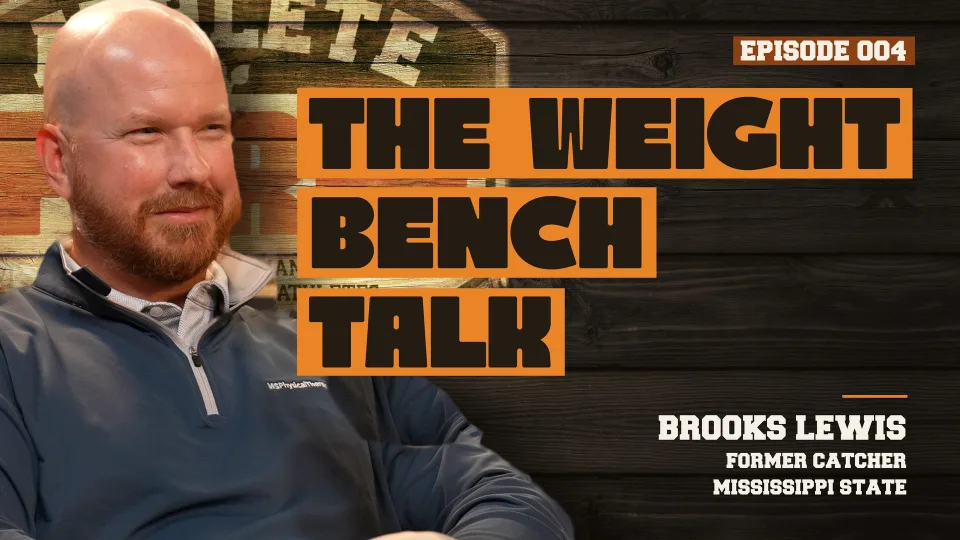
Brooks Lewis is a physical therapist who walked on at Mississippi State under Ron Polk, spent time as a bullpen catcher, and now co-owns three Mississippi Physical Therapy clinics. He coaches his own kids, answers yes whenever they ask to train, and tells parents to chase the experience, not the scholarship.
Full transcript
0:03Mike Frascogna: Welcome back to Athlete Farm a parenting almanac for growing athletes. I'm Mike Frascogna III under the third and today I have Brooks Lewis with me. Brooks is infinitely qualified to be sitting here with us today because he checks every box there is. So he was an outstanding high school baseball player. He was a college baseball player under legendary Ron Polk at Mississippi State and for those of you that know college baseball, Mississippi State is the mecca of college baseball regardless of what anybody else wants to say and and Ron Polk is who built that place. So he played under Coach Polk. He is also a physical therapist and does a lot of interesting things in that physical therapy, so he knows exactly how injuries occur and what to do for them. He's very progressive in that stance. And, again, most importantly, he's also the father of two athletes, and that would be Sam Lewis and Blake. like and so he's got a third grader and a fifth grader that are involved in multiple sports and so all the things that you know as a physical therapist and as a former athlete yourself you get to put your money where your mouth is and apply it to your own kids you also coach your kids in some sports and have the experience of playing for your dad he was a high school but your high school baseball coach so you've seen you know being a parent and a kid in youth sports you've seen it from all kinds of different angles and I can't wait to get your opinions on all these things so this will be great so thank you for being here first of all thank
Brooks Lewis: you for having me Mike I really appreciate it man
1:42Mike Frascogna: absolutely all right let's start with this just get me from Heidelberg Academy to Duty Noble Field in Starkville and and give give me that experience what was it like being a collegiate baseball player and what did you learn from it that you're still now applying later in life and with your own kids?
Brooks Lewis: So the funny thing, my dad, I was working out right before I went to state. So I was in the gym, and it was August, it was hot. And he comes in there and says, hey, can I have a few minutes of your time? I need to tell you something. And I was like, sure, whatever. So I sat down on a weight bench, and he sat down on a weight bench, and he goes, you've always been one of the better players of any team you've ever played on. I said yeah thanks dad and he said you're about to be the worst player on the team in a few weeks so you've got a couple options if you want to stay there you better be the first one to get there and the last one to leave and have the best attitude and best effort of any of them and that kind of hit me in the face I was like and I played summer baseball with a lot of great players that signed division one scholarships and all of the things but he was right I mean I had to work my tail off and I get to Mississippi State fall of 2004 the first playing year was 2005 I ended up I was smaller so I redshirted which gave me a great opportunity to put on some weight get in the weight room and really you know high school weight room was very different back then than it it is now but it getting in that college weight room really helped me get bigger faster stronger but my time at Mississippi State was great that lesson he taught me and I knew that before I left just to work hard and and and do everything I could and let my basically let my abilities be the thing that held me back not my work ethic or how hard I worked so he my dad coached me in football and baseball to clarify I was an all -state football player in high school and all -state baseball player in high school so I really had a good foundation but that that first fall at Mississippi State was the really the thing that really kind of hit me in the face and and showed me like these guys guys are really good you get
4:19Mike Frascogna: to that level I don't care where it is you know it's I mean you were playing baseball at the highest level but even division three I I because I played a year division three football before transferring out but you know people mistake that for well it's division three it's not that if you're playing college sports you show up and there is talent everywhere and it does not look like high school
Brooks Lewis: especially back then because there was no social media there was no real way unless a coach came to see you play they didn't really know who Mike was or they didn't know who Brooks was and you could have had a bad day and still been really good at Division three my sister played Division three and was really really really good in basketball but she had hurt her knee and that's that's the reason she didn't get another look so it's much much different back then when we when we play so
5:12Mike Frascogna: you you had a sister any other siblings just
Brooks Lewis: a sister she's six years older than me okay
5:17Mike Frascogna: so you've got you and a sister you both end up being college athletes so you come from a family where you're you know your parents are batting batting a thousand both of you ended up playing college sports how did they how did your parents treat sports with y 'all growing up you know how was it how was it integrated into family life clearly with your dad as a coach it was almost naturally there and what was the expectation that you will go on and play college sports or did did that develop a different way
Brooks Lewis: my dad was a junior college baseball player played for a couple years at Jones and then went to Mississippi State just as a student but I don't really ever recall there being a expectation it was just me and my sister kind of had it being around the game as much as we were and I was going to games when I was you know old enough to walk so it was one of those things that we were just around it so much and we loved it like it it was one of those things it was part of us and I can I can remember my sister shooting free throws probably in the ninth grade and I would rebound for her and she would shoot over and over and I've seen her make 100 free three throws in a row. Like, it was just, but that's the kind of work that she put in, and it wasn't ever, hey, get out there and do it. It was just, we just went out there and did it.
6:44Mike Frascogna: So that was something that you all were choosing to do. So there was never a mandate of you must go do this. What about, you know, growing up, you know, back then was different. So did you, who did you work with to hone your skill? was it just I'm going out in the driveway to shoot free throws because it's fun or did your sister have a shooting coach that you went to did you have a hitting coach you went to and a pitching coach and you know did you go to an array of specialists or no
Brooks Lewis: no it was just get out there and get after it like I said I would rebound for my sister she never caught baseballs for me or footballs for me but my dad was a big part of that you know when when he would get done with practice he didn't just go home his kind of rule and I've made it my rule with my kids if my kids ever ask me to work with them my answer is always yes it is never a no now I will I'm not gonna lie I will encourage a little bit hey you need to get out there and shoot or you need to let's let's go throw but if they're ever tired and run down it's not one of those things I make them do anything and I was never forced to do anything it was always I wanted to do it right
8:07Mike Frascogna: well how do you do what about what about now with your kids this this new landscape that we're in where we have we have all kinds of specialists and you know I call it an arms race amongst parents right where if your kid is going to a speed coach once a week well then I better go to where I'm going to be left behind if you got a hitting coach I need a hitting coach if you're going once a week I need to go twice a week how do you navigate that landscape how how how do you survey that and how are you approaching it and navigating that
Brooks Lewis: it's tough because I'm even even getting to the point where my son is nine and he'll listen to somebody else a lot of times more than he'll listen to me well I have the fortunate ability to have made connections wade brawls is one of my great friends and we're coaching the same baseball team so with wage trained I division one college athlete himself he he can talk to mine sometimes sometimes a little easier than I can even talk to mine but it's really tough and I don't knock any any of the specialists that are training kids they're they're trying to make a living like Philip short he is fantastic he is such a wonderful human being and my kids love him as their PE teacher yeah but I know all the stuff that Philip does so I don't feel like I have to go and and pay for that I don't feel like I have to put my kids into that once a week now we do some private lessons in soccer with my daughter just because I didn't play soccer I don't know any of the entities of it so it's one of those things that you know if I'm not an expert in and I will get them help if they need it but I don't feel like I have to put them in something once a week or I don't feel like I have to do that I feel like I have to spend the time with them just getting reps in at the house yeah
10:13Mike Frascogna: that's that's really an important part too I think they can get missed and and the fact that you said if your kids ask to work with you the answer is always yes I think I think it's a great policy I try to do the same thing even if I don't feel like it at the time because if they're asking for it you strike while the iron is hot absolutely and you you you let them have that but if you know if they're requesting something is there a line that you draw that you go no now you're asking for too much or is your approach if you're asking to go eat at the buffet I'm going to throw the doors open let you gorge yourself because because you want it or do you or do you set some guard rails there
Brooks Lewis: are a few guard rails and we spoke on this earlier that you know if I feel like they've been to three sports in one day and they're just they need to rest sometimes they just need to rest but most of the time they they'll they'll do that themselves they'll they'll say dad I'm I'm good I need I need some food I want to go to bed but I do think you there's a there's a give and take there you can't be too you know open to them just getting as much as they possibly can even if they want it but I mean that's how the great ones are great right that they want it all the time and they you know that that that's where I think greatness happens working when you're tired you can make some bad habits when you do that but it's also you know if I can do it when I'm tired it's kind of that fourth quarter mentality that other person's not going to work and I always say you're either getting better or you're getting worse there's no such thing staying the same because somebody out there that's wanting your spot is might be working for it so they They hear all this stuff from me. I'm sure it's just coach speak I learned from my dad. But it's fun. It's probably my favorite time in my life has been right now. And I played in some fantastic environments. The old Alex Box Stadium at LSU. I would almost rather be working with my kids at home. It's just a wonderful time. We're so blessed.
12:37Mike Frascogna: So you you're talking about work ethic and I and I agree with you it's that's that's at least as a parent I think that's the most satisfying thing for me to see is that if my kids want to work because I know that applies everywhere in life it's not it's not just for this sport it applies everywhere that desire and that want to work I I would trade most anything just for that and you don't get it all the time but when you do I think that's pretty special where does that desire do you think come from because you can't force it right it's you know you want to see it but as a parent you can't force them to have that desire to want to work and I agree with you the special athletes the best of the best you know we talked about the goats in every sport you know They were insanely dedicated to the work and to the craft. Where does that come from?
Brooks Lewis: I think it's a two -fold thing. I think it comes from watching. So what is dad doing? Is dad laying on the couch watching TV, or is dad constantly trying to make things better? Same thing with mom. Are there examples in their life that are kind of leading them to, to, hey, dad's getting better at that, I wanna get better at that. And it could be from shooting your compound bow. If dad's out there practicing, you see that practice and that it pays off, that he gets the deer or whatever. But I also think it's a little bit of success driven. So when you practice something, and I've seen this with my son especially, he's not as gifted as my daughter as far as athleticism goes, goes but the more he practices something he goes I can do it like I'm getting a little bit better at this so I think that kind of feeds him a little bit and goes man I'm getting better at this I want to work at it more I want to work at it more because he he is my worker my daughter is the gifted and he's the one like he'll just he'll work you to death and
14:50Mike Frascogna: you and I both know that I mean there's so many examples of the worker is the one that ends up going further than the one that it was gifted. And it's, again, I think it's that discipline of having to overcome obstacles so they don't get freaked out when they, you know, when you, you go to Mississippi state and like your dad said, you're going to be the worst guy on the team. You weren't freaked out by that. You just knew how to handle it because you know how to show up and work and I'm going to control what I can control. So I think that's the benefit of that, that work ethic. Let me, let me ask you this question. This is something that, that I wrestle with now. And so I'm just curious of your answer when we talk about you know the greatest of all time in certain sports oftentimes those athletes come from some sort of a very tough background you know socially or economically many times you know they grow up poor and you know you hear stories about I didn't I didn't have a soccer ball I used a wadded up you know you know ball of newspaper flat that's what I did that's what I trained with and I was obsessed with it all right so that that's so oftentimes the the narrative behind the the great ones is it possible to produce that same amount of greatness if you come from comfort because you know we live in in in our area here right there's not there's not a lot of kids that are suffering
Brooks Lewis: right absolutely they're
16:19Mike Frascogna: good they're good they They may not think they're good, but we know you're good.
Brooks Lewis: You're good. Is
16:24Mike Frascogna: it possible to become that level of greatness if you weren't coming from an area of hardship, if you're coming from abundance?
Brooks Lewis: That's a good question, a very, very good question, because I think our level of abundance can be where you get so much more training because you can afford it. I talk to our baseball team and my flag football team all the time. Y 'all are spoiled little Madison kids because they are. I mean I I'm not gonna say I didn't have everything growing up because my parents you know they would eat peanut butter and jelly sandwiches just so I could have the best baseball bat but I think it's possible it's just that's that's a that's a really tough question but I think it goes back to the what are they seeing mom and dad do what's the what's their kind of work ethic what what about everybody around them what are what are their teachers pouring into them because it's real easy to be comfortable it's not easy to to go the extra mile and get in the extra reps when it's 105 degrees in july so that that's a great question I don't know if I have the the all the secrets to that I do I do think it's possible because some kids are in the big leagues are in the NFL and they were well taken care of the
17:49Mike Frascogna: manning seemed to be doing just fine
Brooks Lewis: they're doing just fine right yeah you know Konnor Griffin is doing just fine and I don't think he hurt for much I know miss Kim would probably be upset with me for saying that but I think he's doing well I think Jake Mangum's doing great you know there are instances in that but I think they had great role models and examples of kind of what to be like I actually
18:14Mike Frascogna: really I really like your answer of what your observation is that it's the example of the parents, and it's not necessarily in sports. I mean, we take somebody like Jake Mangum. I mean, he had a great role model in his dad. John had played for the Bears for so many years. But forget about the parents in sports. You just talked about things like do I see my mom or my dad work diligently at something to be better, and that's actually what they're learning. It's the commitment to a task to do it the best you can the best to the best your ability and to you know Improve whatever
Brooks Lewis: it is. Whatever it is. It
18:51Mike Frascogna: doesn't matter and you hope that they pick that up, And then apply it to I mean whether it's sports or their academics or whatever So I really like you I like the angle that you approach that from it's it's the parent setting example Which also gives parents something to work with who weren't college or pro athletes themselves is like that doesn't matter right you just you can teach them that base level skill absolutely that's I think it's a that's a great answer it's a great answer job when you were at mississippi state did you go there on scholarship I
Brooks Lewis: was a walk -on to start with okay eventually earned a scholarship but I was an invited walk -on I went to camp up there from the time I was was probably 14, 15 years old. I also went to the camps at Delta State, which, man, Coach Kenison ran a great camp. But yes, I was a walk on. But the cool thing about Coach Polk's process is he treated everyone the exact same. It didn't matter if you were a walk on or you were on the most scholarship that there was. And back then, we had 11.7 scholarships, right. So for For baseball, for 45 guys. So I had teammates that were just on books. A lot of partial scholarships. A lot of people don't know that. No one was on a full scholarship. Nobody? Nobody. Wow. And I'll even mention Jake Mangum again. He played in that era as well, and he was fortunate enough his parents could pay for it, so he gave up his scholarship so somebody else could have it, and he could have somebody better around him. Wow, that's cool. And I'm sure there were instances of my teammates that were the same way, but that's why Major League Baseball won so many times on that kid that maybe couldn't afford school, so he had to go to the draft like his parents could not pay for school. Right. So when I played, there were a ton of guys that were walk -ons that were great contributors for our program. and that's something a lot of people don't know which is it and I'm glad it's changed now you don't see that anymore at mississippi state they're they're all on full scholarship they're all making money but they deserve it yeah well
21:17Mike Frascogna: nil changed that landscape completely well let me ask you this question though because I no doubt you have fond memories of playing baseball at mississippi state those memories of being there I suspect you would have had the exact same memories and experience whether you are on full scholarship partial scholarship or no scholarship the entire time would that have mattered at all to you
Brooks Lewis: not at all didn't matter to me I wanted to be I grew up a mississippi state fan I grew up going to games and I wanted to put on the maroon and white I had opportunities to go elsewhere where I could be on scholarship but the the education I wanted to be an engineer at the time I ended up picking the wrong engineering field or I'd probably be a mechanical engineer today if I picked mechanical engineering but it wouldn't have mattered at all I bled sweat fault through all the conditioning and all the the strength stuff just like all my other teammates did it was it was more of the bus rides the the hanging out with the guys the relationships that I built while I was there that I'm more grateful for than any any scholarship or anything
22:36Mike Frascogna: no doubt your ego would have probably loved to have full scholarship just and I I get that part because I had a similar experience in college so I understand that but I I'm not I'm not shocked in the least of how you just answered this question because it's how I felt like my ego would have loved a scholarship but I would I will happily pay to be there and to be part of what I was part of you know just like you feel so what advice would you give parents out there now who in their mind they're chasing the college scholarship what how do you how do you explain to them that that's not I don't think this is what you're gonna I don't think you're gonna tell me yeah that's the goal because you just said it's not you didn't you didn't need it but I think you commonly hear parents say well you know we're trying to get a college scholarship and like is your kid not going to college if you they don't get us no they're going I mean you can afford it your student they're going to go to college so what what is the allure of the the scholarship anyway and is that what they should be chasing or would you give them different advice
Brooks Lewis: I would say I would chase the experience you know You want to go play there, whether you're on scholarship or not, because you put your ego to the side, and it's not about that. It's about, and we go back to a team atmosphere, it's about the team. It's never about the individual player in any sport minus maybe golf, maybe a little tennis. But they don't give out any individual championships in baseball. They don't give out any individual championships in football. ball the last time I checked you know I watched that saving documentary he didn't take credit for any of that that was his teams that did that so I would I would chase hey let's go be a part of something that's greater than yourself yeah that that's what I that's what I did you know if I and I've spent a lot of time as a bullpen catcher you know if I could make that picture just a little little bit better my walk -on self did my job you know and that's what I would say to go chase be the best you can be and and that's what you need to be chasing not to see an end result of oh I got a scholarship because some walk -ons billy puckett is a walk -on that played at tiger stadium last week and it didn't go the way they wanted it to do wanted it to go but he got his shot in front of a hundred thousand people on you know saturday afternoon yeah so I would say don't chase that scholarship chase the experience chase going to be a part of something greater than yourself
25:23Mike Frascogna: I I think that's good advice especially when you step back and you look at the percentage of high school athletes that play college sports of any kind it's small and so just by virtue of being there and having that experience you you have already separated yourself absolutely and done something most people never get to experience most people never get to experience you know being in duty noble stadium and left field lounge and I mean all the cool things that around that stadium what what is your most memorable moment of duty noble stadium while you're at state I
Brooks Lewis: would say of 2007 we won the super regional there at duty noble just to see you know and we had kind of we'd always been a solid program but that was the first time we had been to Omaha in eight years I think so to get back to the stage for the national championship was just electric that that environment they said 12,000 people were there that's a lot there were 15,000 people plus there and it it was everybody was standing pretty much the entirety of the games yeah which was much different I mean duty noble is a fantastic experience but it's almost a big tailgate a lot of times you're not even paying attention to what's going on there was not a single pitch that was not a paid paid attention to that weekend who'd
26:52Mike Frascogna: you play who was it again Clemson that was Clemson
Brooks Lewis: okay and Clemson and was really really good that year and we beat them two games and it was it was fantastic yeah and I don't think we even had our best team in 2007 talent wise but we had some older guys that were great leaders a mix of young guys that ended up being really really big for us and we probably had the best best relationships and team as we did the five years that I was there yeah
27:26Mike Frascogna: well that's you know no doubt it was a special experience for you I bet it's fun for you to take your kids back up to Starkville and go to baseball games that's a that's a that's a fun feeling for you I'm sure
Brooks Lewis: the alumni game last year they had 10,000 people for an alumni game holy cow and it was the the bigger names, the Jake Mangums, the Rowdy Jordans, and the Tanner Allens, and Jonathan Peppel -Bonds. And it was really cool to have my 8 -year -old at the time standing on the field watching batting practice, talking to my old teammates. I mean, it was really cool. He was like, Dad, this is really neat. I'm like, I don't think you understand how cool this actually is. Yeah. To get pictures with Will Clark and Rafael Palmeiro and Jake Mangum and Adam Frazier alike. He was just on cloud nine the whole time, and I was kind of giddy myself. Yeah, sure. I'm not even going to lie. Well
28:23Mike Frascogna: and that's the investment you made while you were there. It's what earned him the experience, which is priceless. So as far as youth sports go, what's your philosophy, your outlook on multi -sport athletes versus single sport, hyper -focused on one sport athlete? athlete where where is it healthy where is it unhealthy is there a point that there's a fork in the road how do you see it
Brooks Lewis: I think and college coaches will probably tell you that they want athletes they don't want specialists they want a kid that's playing football basketball and baseball or a young lady that's playing soccer and she's also a cheerleader and she also plays plays golf. So I think do as many sports as you can for as long as you can. That that's just my opinion. Because it makes you more of a well rounded athlete. So when you get to high school, your later years in high school, or when you get to college, and you start putting all your attention into one, that's when you can really, really shine and your coaches and everybody can can see that, hey, this kid's not just a hitter. He can do anything. Or this young lady's not just a, you know, a golfer. She can, like, she's just athletic. And she can handle, and I think being in multiple sports teaches you to handle adversity. Because you're probably not always gonna be the best at everything and failing. And that's what I love about baseball, is you're going to fail at least seven out of 10 times. And you had a pretty good season. You might be in the Hall of Fame if you're a big leaguer. You hit 300. I mean, that's crazy. So if you're well -rounded and well -versed and been through a lot of experiences, I think that's the way to go. And if you don't get a college scholarship, hey, you had experiences in multiple different things. You were able to develop more relationships relationships and more connections I think that's the way to go in my opinion I
30:42Mike Frascogna: think that I agree with you and I and I think most people agree at that level I want an athlete just a good athlete who's a competitor that I want that and I think most people would agree with yes let's play as many sports as possible I think where it gets difficult is the more practical aspect of what what parents then bump up into, and they say, hey, you know, we're in October right now, and, you know, our travel team, baseball team has a tournament this weekend, which I remind people fall is not baseball season. But we got one more, you know, this weekend, and our soccer team has a tournament that's over here, and our flag football coach is saying, you know, I'd really like to practice to maybe try to refine something before a game since we're in the middle of football season, and we don't know what to do. And that's where the rubber meets the road of multi -sport athlete sounds great, but how do parents navigate this?
Brooks Lewis: It's tough. It's so tough. I mean, you deal with it. I deal with it. That's the toughest thing is being a coach in all of these sports is because they're all playing three or four different things, and their attention's being pulled three or four different directions. I do think it comes to a point down the road where you're going to have to pick one or two sports that you're going to put all your attention into. I'd like to go back to where we had football season, we had soccer season, we had basketball season, and we had baseball season. But it's never going to get back there.
32:24Mike Frascogna: I agree. I agree. I think that you've got certain sports that have just ballooned into, we're year -round sports. And if you're not participating year -round, maybe even if it's not said, the implication to the parent, the suggestion is, if they're not here, they're falling behind. Right. And they won't get on the next team we pick. Right. And so the parent's in a difficult position of, what do I do? Right. Am I going to do my kid a disservice by drawing any kind of lines and we're not going to participate with you? Right. It's tough.
Brooks Lewis: It's very tough. I mean, my 10 -year -old girl is going to face that probably next year. You know, she's an unreal athlete. Soccer, she's fantastic at it, but she just doesn't love it like she loves the others. and that's where I think you probably have to separate those and go does does she really love her does he really love this and you can probably weed some of those sports out by saying that and that's just sitting back and having an objective look not what you want them to do but are they really good at this do they really have the desire to compete and work in it that's you're gonna have to make a tough decision but I think that's kind of how you make that tough decision have
33:56Mike Frascogna: you are there sports that your kids play that you don't coach are you coaching everything I
Brooks Lewis: don't coach golf okay because I'm terrible at it yeah and I'm coaching baseball and flag football but I'm assistant baseball coach and I've loved that okay his seven -year -old season I was the head coach and I was basically the manager and in charge of tournaments and all of the things and when he was eight I had a chance to step back and I loved it because I could just coach I didn't have to do all the managerial tasks but I'm the head coach of the flag football team and that's probably my favorite sport really I played baseball at the the highest level but the flag is just it's so relaxed and slow laid back and I know when we go to fifth grade it's going to be completely different yeah but being from my dad my dad being that football coach he he was more of a football coach than he was a baseball coach but him and I was around football all my life from a very very young age and the competitiveness and the the feel of a friday night there is nothing like that I mean I played at the highest level of baseball in the sec you could play at but dang there's something about a friday night that's awesome and to answer your question my wife pretty much volunteers me to coach everything I did not want to coach fifth grade basketball for my daughter but I said I will help so I I hope I get to sit on the sidelines and work on substitutions or something like that and just and be a present voice that's encouraging because that's what I see in youth sports today is they beat kids down way too much instead of building them up and that's I've made a conscious effort to encourage and encourage and encourage and pour love into of these kids more so than just tell them all the things they're doing wrong and
36:10Mike Frascogna: I was going to ask you it's going to be hard for you to answer this because right now you're still coaching pretty much everything so I was going to ask you how do you judge whether or not your kid has a a good coach for their sport youth coach what are the traits that make a that make a good coach and again that's hard for you because there there's a bunch of parents that are just judging you right now you're you're not on that side really looking in so what would you what would you hope that they would be judging judging that coach on what do you look for
Brooks Lewis: I hope that and I can say I hope I can say this about myself that if I if I correct something or if I get on to a kid for doing something they shouldn't be doing that I'm coming around them and putting my arm around them later and encouraging them and filling them with joy and encouragement and love because that I feel like that's the best coaches that I had or the coaches that truly cared about me and cared about what I was going through and what I was thinking rather than just always beating you down I played for a bunch of coaches growing up my dad did not coach me until I got to junior high and he made a point to he wanted to sit back and let me do my thing and let other coaches coach me now when we got in the car on the way home we would talk about it but it it was never man you stunk today you went over three it was well how was your attitude on the way back to the dugout or how was your effort today and those are a couple things that he never had to worry about I spiked my helmet one time when I was about 10 years old and we had a conversation about that that I would never do that again but that that's that's what I look for in a coach is are they going to pick you up in your times that you're down because all sports are tough kids Kids go through a lot of stuff. They get, you know, mine aren't on social media yet, but it's not far away. You know, those are the things that everybody's going to tell them that they're great or that they're not great. And do you have positive, influential people around them to push them in the right directions rather than continue to push them in the wrong directions? The
38:40Mike Frascogna: questions that your dad asked you after the game, so you struck out and the questions that he asked are what was your attitude on the way back to the dugout and what was your effort level those are interesting questions that that's what he chose to ask why do you think those are the questions he chose I
Brooks Lewis: don't think he ever wanted it to make it about performance but it was more about competition so if I struck out on the way back to the the dugout was what are you thinking about going into the next one what's your mentality like oh he got you that time but what's the mentality like next time because if you let a great athlete you're you're one of them they're all over the world they don't worry about the last one they worry about the next one those are the best athletes on the planet can can scotty scheffler forget about the sprinkler head that he hit you know and he got a bad break is he hanging on to that shot the whole round or does he completely wash it go get the next one right that that's what he was preparing me for because he knew that there would be times where I just had a bad day happens and it was never about so it was never about performance it was always about well what were you thinking going into the next one you know he got you on a curveball well what were you looking for when you went back up to the plate the next time yeah I
40:06Mike Frascogna: think it's good advice I would also maybe suggest that the reason he chose those questions is because those are two things that are always under your control a hundred percent your attitude is under your control your effort level is under your control so even if everything else is swirling around us we have no control you can control those two things and you don't want either of those to be the reason you didn't get the result absolutely you wanted you can always take care of those two okay so youth sports we all know and and have have seen before the kind of the two extremes when it comes to winning so we have the you know I'm going to you know I'm I'm a opposing parent or coach that you you know, wants to rip your throat out and we're going to win at all costs. And then you got the other one that goes, oh, you know, we're just here to have fun. And and they go, oh, for the season. Where's the balance?
Brooks Lewis: I am. Everybody wants to win. Right. And if you don't want to win, you shouldn't be there. But I think it's all about the competition. and I think sports youth sports are a great avenue for our children to learn lessons because how do you respond when you don't do well like you mentioned your attitude and effort I probably say that to my kids every day or every other day like you can control those two things whether it be in your studies in your games in your practices whatever it may be and and then how do you respond when you lose? Does it make you hungry to never do it again? That that's what I think we need to get to of not win at all cost. But let's compete as hard as we possibly can for as long as we possibly can. If it doesn't go our way, be respectable, shake their hands, and let it make you you hungry for the next time. Because that's life. You know, that's, you're not going to win everything in life. I haven't won everything in physical therapy. I have made dumb decisions that impacted everything. But that that's how do I respond? Do I change my behavior and get better? That those are the questions that I want to answer. And I always always want to answer them is yes, I'm going to compete. And that's what I want for all my little athletes that I coach. Did you compete today? Did you have good attitude and effort? Does this loss does that make you want to win again? Yeah, that that's what I think I want to be known for. Yeah
42:59Mike Frascogna: I think that I think that's all healthy advice. So let's, let's, let's switch gears a little bit, because you just brought up physical therapy, let's kind of switch over to the, the professional side of you because you see you see a lot in this area that also applies to sports quick just background on you're a was it a kinesiology major
Brooks Lewis: kinesiology major started in chemical engineering -huh got hurt I tore a ligament in my hand had surgery in the summertime kind of had to do my rehab myself because I was at home and not in starville and that's kind of when I switched gears and changed my mind and said hey I want to help other people do this so I went to PT school here in Jackson at UMC there for three years I moved to Memphis and started with a company named Results Physiotherapy and when I was in PT school I never wanted to work on a spine in my life I just said no that's I want to work with athletes athletes. And that's the only thing I want to work with. then I met a gentleman named Adam Reisinger at results and I did a clinical rotation with him, an eight week rotation with him. And he pretty much, he changed my life. he showed me pretty much how to treat a spine correctly, and taught me that if you ever help somebody with back pain, they would never forget get you and it's that's pretty spot on so I went to results just specifically to be a manual therapist and I full disclosure I will treat anything that walks the door I've got a couple acls right now athletes and I love working with athletes but I love working with the weekend warrior that is trying to do a high rocks competition or a crossfitter or whatever ever for
44:59Mike Frascogna: the record you just described my wife who is a regular client of yours
Brooks Lewis: yes I I have we opened mississippi physical therapy my partner john and I almost five years ago it'll be november 1st will be five years okay we've opened three clinics and five years and we serve pretty much the metro area anywhere from eight -year -olds to hundred -year -olds okay we specialize in manual therapy and dry needling so those weekend warriors that have a knot in their trap or a tear in their calf or a hamstring that's bugging them or whatever it may be we we try to get them back to what they want to be doing explain
45:46Mike Frascogna: explain for those who are not familiar with dry needling exactly how that works and and I and and does it apply to youth athletes as well and I I'm pretty sure every youth athlete is saying please god say no it doesn't apply to me because it sounds like the worst thing you could do I'm just gonna stick needles in you yeah the thing you love the most let's go see brooks and he's gonna stick needles in you
Brooks Lewis: it's not as bad as like a flu shot or a decadron shot it is a tiny acupuncture style needle okay it does apply to youth athletes and youth sports because if you strain your hamstring with traditional care it might be three or four weeks before you're back on the field with a dry needle I can usually have you back in a week or two so what exactly does it do how does it work so there are I tell people all the time that works in three ways so when a muscle is strained or tight it it it restricts the movement that you can make. So if less simple example is a hamstring where there's a knot in it in the muscle is shorter than it's supposed to be. When I put a needle into that spot, it causes the muscle to spasm and fatigue and relax. And it makes the length of the muscle bigger, more to its normal potential. So there's a there's a physical component to it where it lengthens the muscle to the the the length that actually should be. It also works chemically where if your muscle is tight and aggravated, it's very acidic in nature. So the pH is very low per se. And a normal muscle is supposed to be basic. So it completely reverts it back to basic, because it allows the muscle to relax the tension to come off all of the blood vessels that pump all of your fluids in and out of your body. And allows all that acid travel travel out of your body and get it back to a normal resting potential and then it works on your brain so if I put a needle in your brain or in your leg not in your brain it affects your brain in a certain way where it it can freak it out and ramp your central nerve system up but when I take the needles out it calms everything down you get that euphoria and your brain goes hey that feels better I'm not so freaked out anymore so all pain comes from your brain whether you have a pain in your foot or your hand or your hamstring or wherever your brain is sending a warning response to go something's not right if I can effectively treat your brain just by being nice to you I can ultimately stick a needle in you and treat it more effectively so it's it's really the cutting edge of kind of physical therapy there are a lot of people that dry needle out there, but it's really finding the exact right spot that you need to put the needle in in diagnosing the problem correctly. One needle, multiple needles? Multiple needles. Sometimes it takes one. It just depends on what's in front of us. I had a 10 -year -old little girl in there last week, and I put two needles in her. She's feeling fantastic, a little soccer player. so it really just depends on a what you can take what what is required for the diagnosis but usually no more than six or eight needles at a time okay
49:10Mike Frascogna: so what about just general injuries that you see youth sports what what are the most common injuries that you see what are they caused by and is there are there preventative measures for these common injuries that parents should be aware of
Brooks Lewis: probably the most common thing if you talk start talking about a soccer player a football player or anything like that is is just muscular strains those are due to lack of flexibility sometimes lack of strength and it goes back to nutrition and hydration as well if you're not hydrated your muscles they're going to suffer from it they're going to get shorter and spasm and a little bit of it I think is this is too much kind of sitting and technology they're not playing outside like they normally are you know when we were growing up and and such things so their muscles are just generally tighter and they're not as flexible as kids used to be and then when you start talking about baseball players it's typically because they have a ton of weakness in their shoulder and they're putting a ton of stress and strain on their elbow yeah so so we see a ton of that in new sports and and I know they they do across the country it's kind of an epidemic of the old tommy john but in a youth athlete before they hit puberty they're going to have porous and soft bone so instead of tearing their ligament they're going to a voles bone and the ligament is going to stay intact and but that is generally caused by weakness in their shoulder and their rotator cuff every every single arm injury I've had elbow injury I've had I walk in and I examine them their shoulder is so so so weak and it just amazes me so preventative measures could be some just general arm care that they do such as so So resistance bands and resistance tubing to make sure that their muscles are ready to go before they pitch or before they play. And even after they pitch and after they play to get their muscles calm down. When you use your muscles a lot, there is a lot of blood flow that goes into the muscle and you're going to strain, micro strain your rotator cuff and muscles in your arm. so it needs to calm back down to a resting potential before you just you know get in the car and go home so just a general arm care routine would be fantastic before and after you you go through high level baseball activity what's
51:53Mike Frascogna: what's your position on weight training for youth athletes
Brooks Lewis: 100 percent and I don't think it necessarily needs to be with weights until they get to a certain age like I I don't need to squat and deadlift 300 pounds if 200 pounds is what I need to do right so especially in youth at
52:16Mike Frascogna: what age what what age should a parent start it should hit their radar maybe my athlete should be in in a weight room to some degree there should be some you
Brooks Lewis: know when they really get involved with sports like my my seven eight year olds really need to start doing some functional things like body weight squats and lunges and sit -ups and push -ups and all of those things. When that resistance gets too light for them, then it's time to introduce them to some weight training. Some of the issues with, you know, junior highs and high schools, there's so many kids. There's so few help to observe and watch and make sure they're doing it correctly. I still have kids that I see with fractures in their back because they were doing something incorrectly in the weight room so
53:11Mike Frascogna: how does a parent approach that if on one hand my my son or daughter needs some strength training right but where am I going maybe you know the school is stretched in maybe possibly somebody's not qualified right where where do they go
Brooks Lewis: most Most, what I would suggest is you can always reach out to someone that is qualified. And what does that mean? Not just Mississippi Physical Therapy. I'd be willing to go to any high school and work with and train and show strength coaches or, like our strength coaches were, defensive coordinators or whoever it may be, of what's the proper form and what's the proper technique. and any physical therapist in Jackson or any of the surrounding areas I know would also volunteer their time to do the same thing we're all working together the key thing yeah we are competing against your elites in your performance rehabs but in Mississippi sports medicines but we're all working in the common good of we want our athletes to be healthy we were athletes to be on the the field and not on the sideline. If they're not on the sideline, mom and daddy and grandma and grandpa can't have fun watching them and they can't have fun playing their sport. So any of us would be qualified to go in and help and run clinics or courses or whatever to make sure that we're doing the right things.
54:43Mike Frascogna: For parents that might want to pick your brain a little bit more, how do they get in touch with you?
Brooks Lewis: So they can go to our website at msphysicaltherapy.com. My email is brooks.lewis at msphysicaltherapy.com. I'm happy for anyone to reach out to me. I'd love to talk. I'm a pretty good talker, as you can see. But I want to help. That's the key thing. I firmly believe that we're on the planet to serve one another. And that's, you ask a lot of questions about why do I coach? That's why I coach. I want to help. I want to help. I want to teach, whether that be in business or to kids or to parents or health professionals, strength coaches alike. I want to advance and make the world a better place. That
55:35Mike Frascogna: is, that's a great life philosophy. I appreciate you being here today and sharing that with us. Definitely an asset to our community and all the youth athletes here. So And can I get you to come back at some point? Absolutely. Because we've got a lot of other things that I'd love to touch on with you and go a little bit deeper on some of the physical therapy and the injuries. So I'd love to have you back at some point, and we'll do a deeper dive on that. Let's do it. All right, great. Brooks, thank you. Everybody, thank you for joining us on this episode of Athlete Farm. I've had Brooks Lewis here with me today. See you next time.
Transcribed automatically from the studio recording. Times are where each question starts in the full episode.